
Friday, February 27, 2026 · Updated November 24, 2026
Legal Focus Group Results From 7 Real Injury Cases

In this post
- The seven cases at a glance
- How to read the numbers
- Dog bite: testing the owner’s conduct against the carrier’s offer
- Gas station fall: testing a liability defense before settlement
- Burn injury: valuing the injury before and after it healed
- Highway collision: testing a $0 offer
- Premises fall: liability exposure after a failed mediation
- Surgery after treatment gaps: testing medical causation
- Birth injury: the missed test and the timing dispute
- Testing evidence in stages
- What the seven cases had in common
- Using the results: demand, reserve, mediation or trial
- Better evidence for litigation decisions
Seven injury cases run through Focus produced 297 completed evaluations from 169 people, with each panel drawn from the venue for its case. Evaluators read the evidence, judged liability where it was disputed and valued the damages. In three of the cases they answered the damages question again after seeing new evidence: twice in the dog bite case and once each in the burn and premises cases. These were online legal focus groups, sometimes called mock juries, run on real cases.
The results cut both ways. In a gas station fall, the defense offered $10,000, and after it saw the results of a $1,500 panel, the case settled for $22,500. In a burn case, the median award fell by half once evaluators saw photographs of the healed skin. In a birth injury case built on competing expert opinions, 46 of 50 evaluators said a basic blood test should have been ordered sooner, while they split on the experts’ dispute about when the injury occurred.
In the malpractice claims Danzon and Lillard studied, fewer than one in ten went to verdict, and settled claims paid, on average, about three-quarters of what the authors estimated a verdict would have paid.1 The cases below show how evaluators in each venue read the evidence, for the attorneys who brought the claims and for the carriers and defense counsel on the other side, and what happened next where counsel reported it. Parties and firms are not named.
The seven cases at a glance
- Dog bite: the carrier’s last offer was $95,000. The final median award was $125,000, and the carrier then asked for pre-suit mediation.
- Gas station fall: the defense offered $10,000. After it saw the results of a $1,500 panel, the case settled for $22,500.
- Burn injury: the median award fell from $100,000 to $50,000 after evaluators saw photographs of the healed burns. 39 of 51 lowered their own award.
- Highway collision: the defense offered $0. The median award before any reduction for fault was $2,000,000, and 33 of 55 evaluators said the other driver caused the collision.
- Premises fall: after a first mediation ended with a $115,000 offer, 39 of 50 evaluators put 81–100% of the fault on the store.
- Surgery after treatment gaps: despite doubts about delays in care, the median award was $500,000, and 7 of 20 evaluators chose exactly that amount.
- Birth injury: 46 of 50 evaluators said the blood test should have been ordered sooner. The median total damages were $13,500,000.
Source: Focus’s records, checked November 24, 2026. Counts include only evaluators who finished each panel. Panels ran from 20 to 55 evaluators, and some people answered more than one of the seven cases. Offers, settlements and mediation requests are as counsel reported them. An award is one evaluator’s amount; an offer or a settlement is what a party did. The two are different measures.
How to read the numbers
An award here is the amount one evaluator entered, before any deliberation. The median is the middle award when the awards are sorted, or the average of the two middle awards when the count is even. The middle 50% of awards runs from the 25th to the 75th percentile, so its lower end shows how low the awards went once the lowest quarter is set aside. The mean is the ordinary average, which a few large awards can pull far above the median. The adjusted mean counts any award above a statistical upper limit, the 75th percentile plus one and a half times the width of the middle 50%, at that limit. The limit is a statistical convention, not a judgment about what a reasonable award is. How to Interpret Focus Group Damage Awards explains each measure in more detail.
Three panels answered the damages question again after new evidence. Because the same people answered each time, the change can be counted evaluator by evaluator. These are observations made in sequence, not controlled experiments. They show how answers changed after the evidence was presented, not that the evidence alone caused every change.
The panels are small, and each evaluator answered alone. The answers show what these evaluators did with the evidence they saw. They do not predict a verdict or what either party would accept.
Dog bite: testing the owner’s conduct against the carrier’s offer
The challenge
The carrier opened at $80,000 and moved slowly to $95,000. Counsel needed to know two things before going further: whether people in the venue saw more in the injury than the carrier did, and whether the owner’s conduct would change how they valued it.
What the evaluators were asked
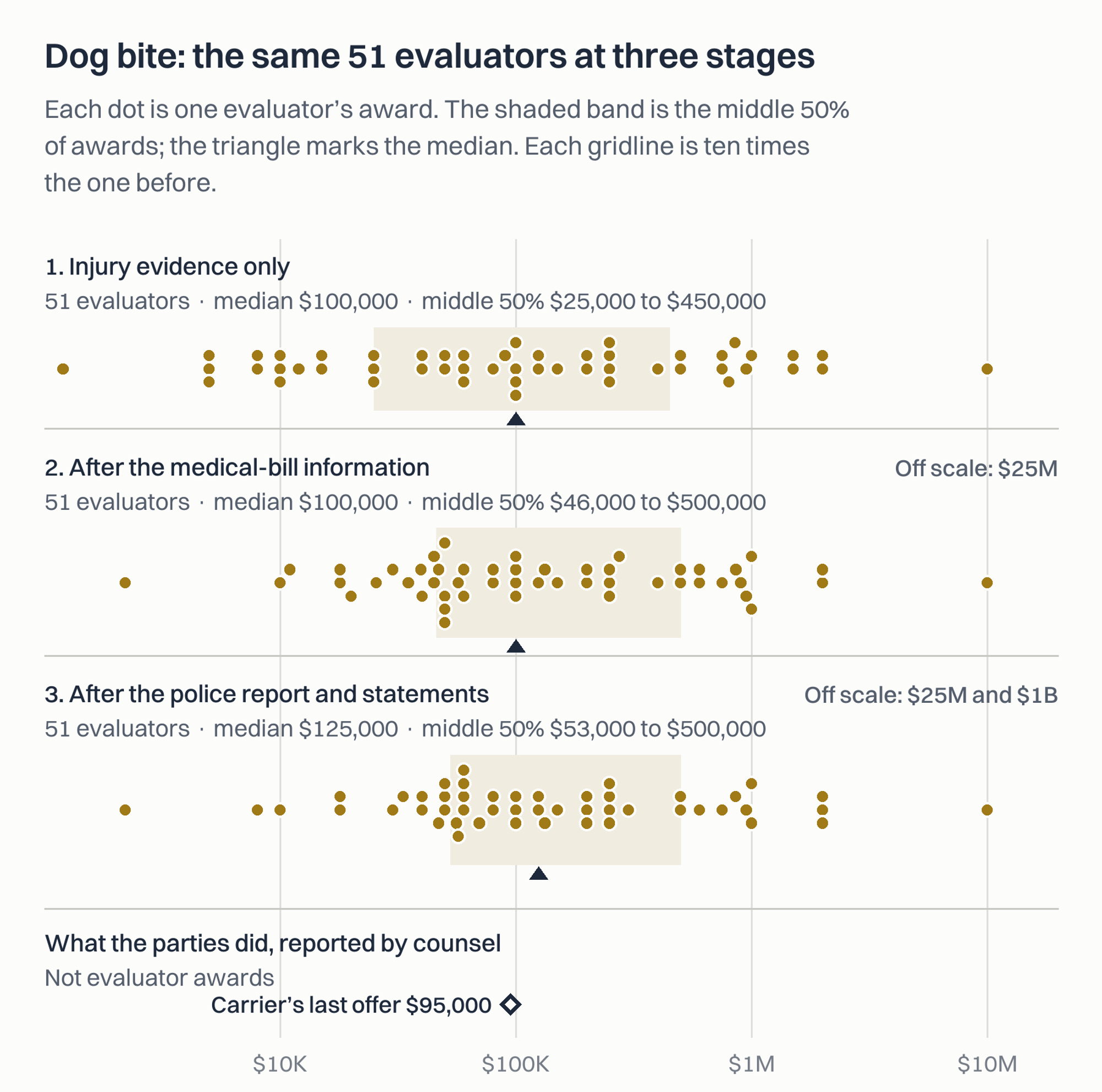
The same 51 Missouri evaluators valued the case three times. First they saw the injury evidence without the medical bills. Then they learned what had been billed for treatment and the lower amount actually paid, and could revise their award. Last, they read a redacted police report and statements about the dog and its owner, and gave a final award.
What the results showed
Source: Focus’s records, 51 evaluators who finished the panel, checked November 24, 2026. Four evaluators said the bills would not change their award and entered $0 as the revised amount. They are counted at their first amount, which each of them entered again at the final stage.
After learning the billed and paid amounts, 25 of 51 evaluators raised their award, 21 kept it and 5 lowered it. The median stayed at $100,000, and 6 evaluators were at $1,000,000 or more both before and after.
After reading the police report and statements, 17 evaluators raised their award and 4 lowered it. The median rose to $125,000, and the number at $1,000,000 or more rose from 6 to 8. Asked what in the report mattered, 28 of 50 written responses indicated no change in view. Of the details evaluators did name, 10 responses mentioned the owner’s denial or effort to shift blame, 9 prior aggression or neighbors’ fear of the dogs, 9 the lack of a leash or fence, and 7 an overdue rabies shot. Two thought the dog might have been provoked.
Asked what most influenced their award, evaluators cited the injury as well as the owner. Of 49 answers, 18 cited medical needs, 14 the severity of the wound, 14 psychological harm and 12 the owner’s duty to control the dog. Five wanted more detail. The highest final award was $1,000,000,000, forty times the next highest of $25,000,000. The adjusted mean counts every award above $1,170,500 at that limit, which puts it at $331,163.
What it means for each side
For plaintiff counsel, the sequence separated two arguments. The injury evidence alone put the median at $100,000, close to the carrier’s offer, with 6 evaluators already at $1,000,000 or more. The police report gave evaluators a documented reason to account for the owner’s conduct. After it, the median rose from $100,000 to $125,000, and the number of awards at $1,000,000 or more from 6 to 8.
For the carrier, the sequence showed that the exposure above the offer did not depend on the bills or the police report: 6 evaluators were at $1,000,000 or more on the injury evidence alone. Both later disclosures raised more awards than they lowered, and only 2 of 50 written responses raised the possibility that the dog was provoked.
What happened next
After seeing the results, the carrier requested pre-suit mediation.
Gas station fall: testing a liability defense before settlement
The challenge
The defense denied liability and offered $10,000 as a cost of defense. Its position had a visible fact behind it: the video of the fall showed wet-floor signs. The question was whether putting up the signs discharged the store’s responsibility while a cooler kept leaking.
What the evaluators were asked
Twenty evaluators watched the video and reviewed photographs, assigned the store a share of fault, gave an award before any reduction for fault, and explained their thinking. The panel was a $1,500 package.
What the results showed
The panel divided almost evenly on fault. The store’s median share was 50%, the middle 50% of answers ran from 28.75% to 82.5%, and 2 evaluators assigned it no fault at all. Of 20 written answers, 10 said the signs reduced or removed the store’s fault. Seven said the store should have done more to control the spill, such as mopping more often or putting towels down, and 5 asked how long the store had known about the leak. Three found the video hard to see or wanted clearer proof, and 5 mentioned permanent scarring.
Source: Focus’s records, 20 evaluators who finished the panel, checked November 24, 2026. The offer and the settlement are as counsel reported them.
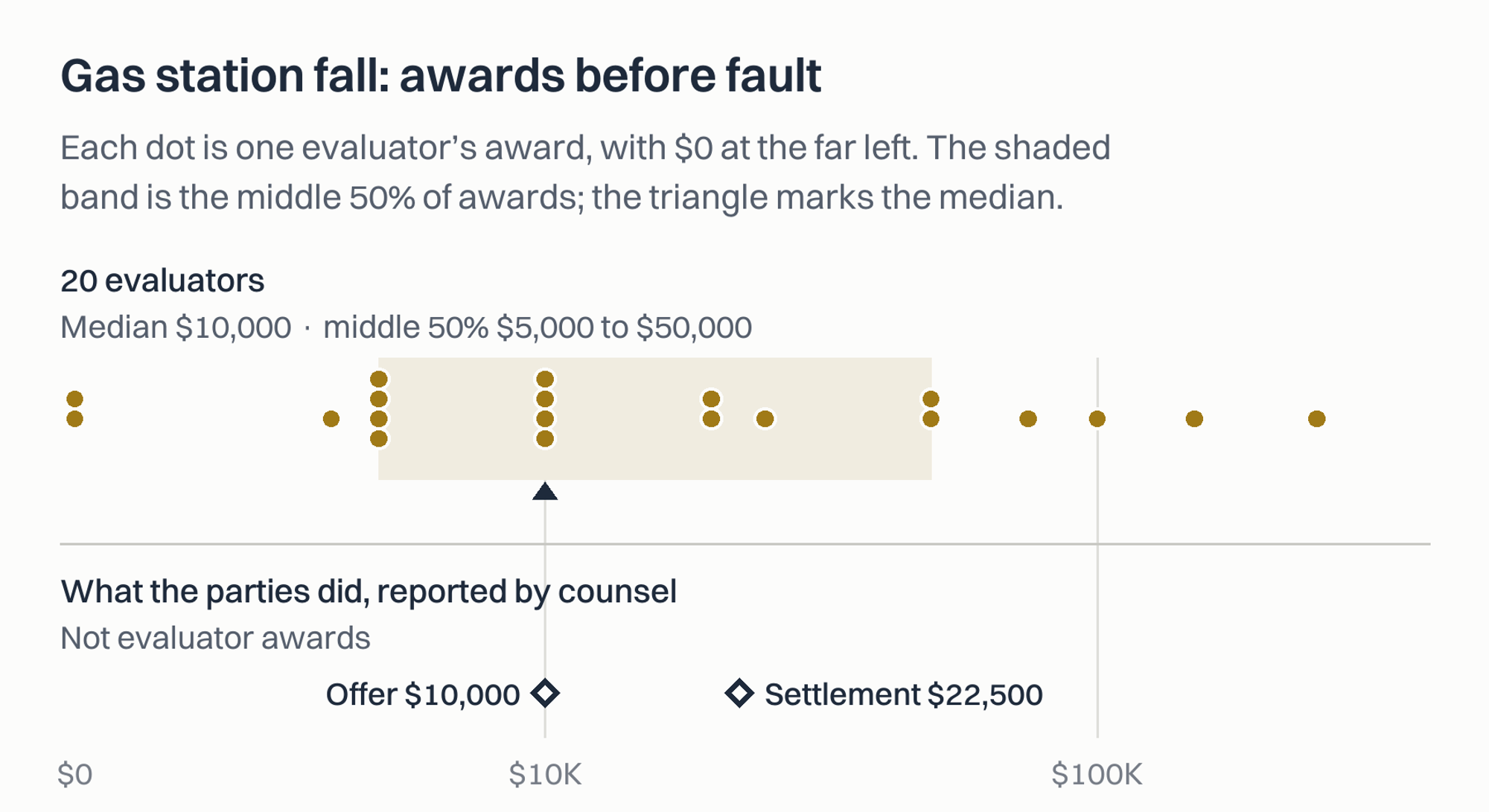
The median award before fault was $10,000, the same as the offer. The middle 50% ran from $5,000 to $50,000. Two evaluators awarded $0 and 1 awarded $250,000. The mean was $40,205 and the adjusted mean $31,955.
What it means for each side
For plaintiff counsel, the written answers identified a theory the signs did not answer. Warning customers about water is different from cleaning it up, and 7 evaluators wanted the store to control the spill.
For the defense, the signs carried real weight. Half the panel said they reduced or removed the store’s fault, and the median award matched the offer. On the separate damages question, though, 9 of 20 evaluators entered more than $10,000 before any reduction for fault.
What happened next
| Offer, panel or settlement | Amount |
|---|---|
| Defense offer before the panel | $10,000 |
| Focus panel, 20 evaluators | $1,500 |
| Settlement reported by counsel after the defense saw the results | $22,500 |
Source: counsel’s report of the offer and the settlement, and the price of the 20-evaluator panel, as given in the February 2026 version of this post.
The settlement was $12,500 more than the offer, an increase of 125%. The figures do not show why the case settled at that amount. They put the cost of the panel next to the gap between the offer and the settlement, in a case worth tens of thousands of dollars rather than millions.
Burn injury: valuing the injury before and after it healed
The challenge
The burns came from a cosmetic laser treatment and lasted nearly eight months. As a 90-day demand deadline approached, counsel had photographs that supported different valuations of the same injury. In the latest photos the burns had largely healed and were hard to see. A demand built on the early photos risked pricing the injury as if it had lasted. One built on the latest photos left out what the patient had already gone through.
What the evaluators were asked
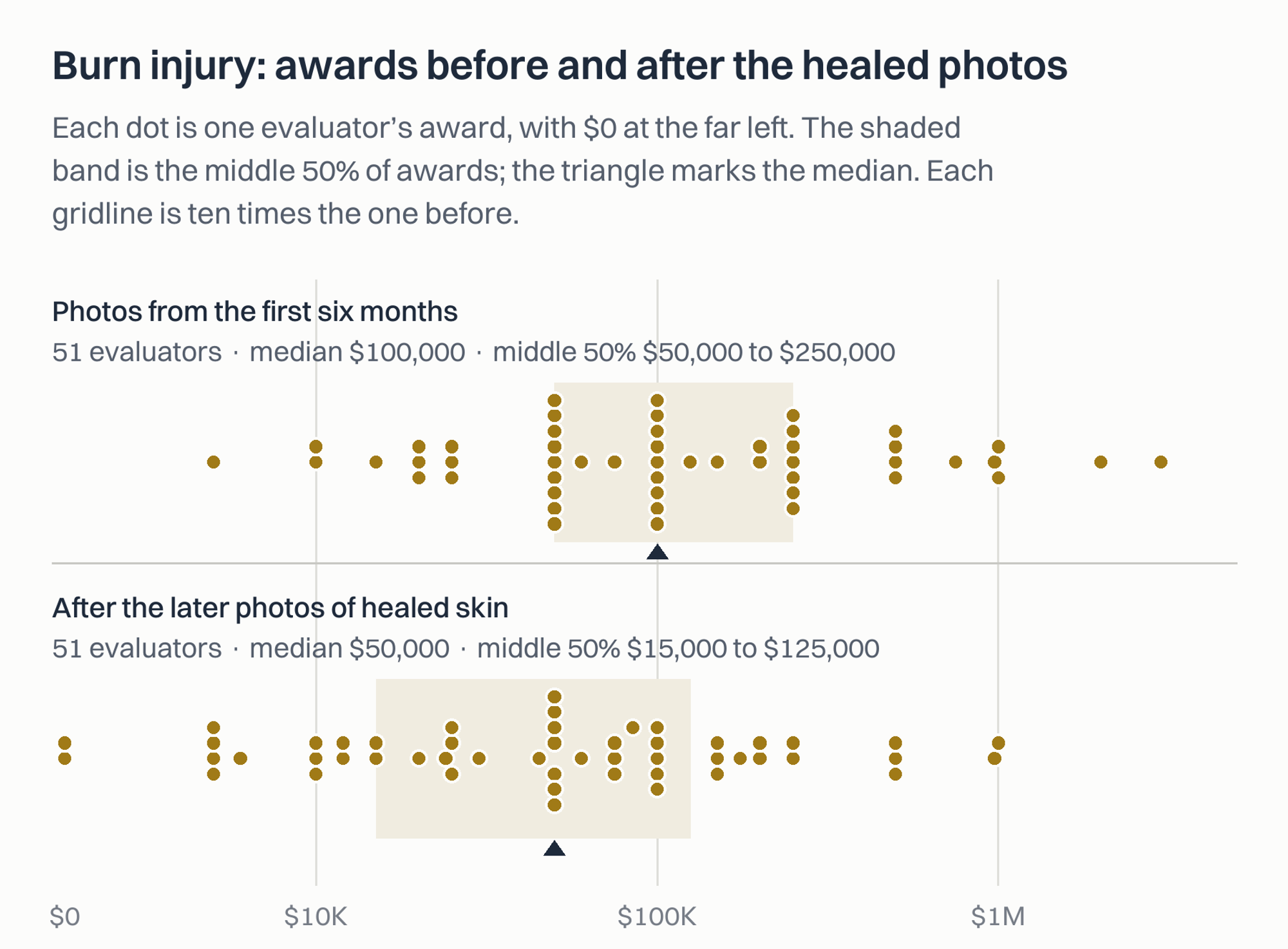
Fifty-one evaluators said whether the clinic should be held responsible, entered an award after seeing photos from the first six months, then entered an award again after seeing the later photos. They also answered questions about the clinic’s partial refund and gave their overall impressions.
What the results showed
Responsibility drew little disagreement: 50 of 51 said the clinic should be held legally responsible.
Source: Focus’s records, the same 51 evaluators at both stages, checked November 24, 2026. The two later awards of $0 are counted as entered.
After the later photos, 39 of 51 evaluators lowered their own award, 27 of them by half or more. Ten kept it and 2 raised it. The median fell from $100,000 to $50,000, and the mean fell 56%, from $290,392 to $127,922. The upper end of the middle 50% fell from $250,000 to $125,000, and the number of awards at $250,000 or more fell from 17 to 7.
The clinic had given the patient a partial refund. Of 50 written answers about the refund, 6 considered it fair. Eleven said the rest should be refunded along with further compensation, and 9 named pain and suffering that remained unpaid. Of 50 overall impressions, 24 wanted more detail on damages, including medical bills, and 14 wanted to see the consent or disclosure form the patient had signed.
What it means for each side
For plaintiff counsel, the results gave a basis for a demand that accounts for the recovery and still asks for the months of injury. Even with the healed photos in front of them, evaluators gave a median award of $50,000. The written answers also named what to add, the medical bills, which document costs a photograph cannot show.
For the clinic and its carrier, the median award was half as high after evaluators saw the healed photos, and 14 evaluators wanted to see the consent form, a document the defense would hold. The case also shows that a panel measures evidence that lowers an award as readily as evidence that raises one.
What happened next
When this post was first published, the defense had the results and was taking them to its client for settlement authority.
Highway collision: testing a $0 offer
The challenge
The defense offered $0 in a case with more than $1 million in medical bills and policy limits in the millions. Its theory was that the injured driver had been speeding. At the time of the panel, the defense had produced no expert support for that theory, but the crash footage left room for it.
What the evaluators were asked
Fifty-five evaluators watched the footage, said who caused the collision and put a percentage of fault on the injured driver. After learning of his injuries, they gave an award before any reduction for fault, compared it with a stated figure of $2.5 million and explained their views.
What the results showed
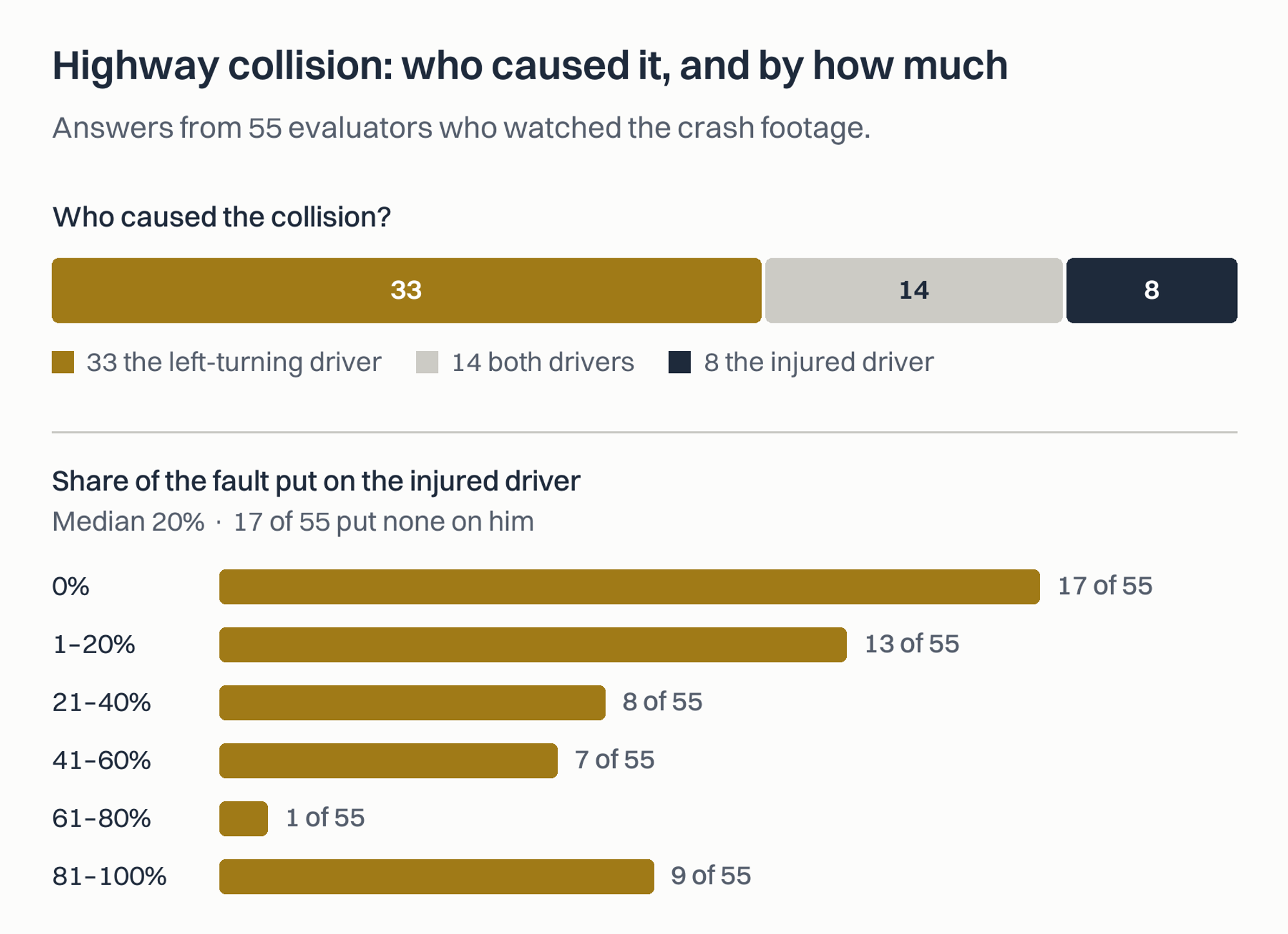
Source: Focus’s records, 55 evaluators who finished the panel, checked November 24, 2026.
Of 55 evaluators, 33 said the left-turning driver caused the collision, 14 said both drivers shared fault and 8 blamed the injured driver. Asked for a percentage, evaluators put a median of 20% of the fault on him. Seventeen put none on him, and 30 of 55 put 20% or less.
The written answers show why the speeding argument still mattered. Of 50 answers, 17 cited the turning driver’s failure to yield and 16 said the injured driver was speeding or racing. Eleven mentioned an obstructed view, and 3 wanted proof of speed. An evaluator could think the turning driver caused the collision and still make a deduction for how fast the injured driver appeared to be going.
On damages, the median award before any reduction for fault was $2,000,000, and 37 of 55 evaluators gave at least $1,000,000. Asked to compare their view with $2.5 million, 44.4% of 54 said about that amount, 37.0% said significantly more and 18.5% significantly less. The two answers respond to different questions. The $2,000,000 median came from evaluators naming an amount; the answers about $2.5 million came after the question supplied that figure.
Five awards were entered as amounts under $1,000, such as 1.5. They are counted as entered. The median stays at $2,000,000 whether they are counted, left out or replaced with larger amounts.
What it means for each side
For plaintiff counsel, a $0 offer was hard to reconcile with a panel that put primary responsibility on the turning driver and valued the injuries in the millions. A demand built on the gross median still had to address comparative fault, though. Without a speed expert, the footage left the impression of speed unanswered for part of the panel.
For the carrier, that impression supported a deduction for part of the panel. But only 8 of 55 evaluators blamed the injured driver for the collision, and 9 put more than 80% of the fault on him.
Premises fall: liability exposure after a failed mediation
The challenge
The first mediation ended with the plaintiff at $3,285,000 and the store at $115,000. Before the second, the parties had to judge how much of that distance came from the dispute over the wet floor and how much from the plaintiff’s pre-existing knee condition.
What the evaluators were asked
Fifty evaluators assigned the store a share of fault and, after reading records from her treating doctors and the store’s expert, said what caused her later treatment. They gave an award, learned what had been billed for her care compared with what had been paid, and gave a final award.
What the results showed
Discovery showed that the store had replaced 82 skylights because of leaks.
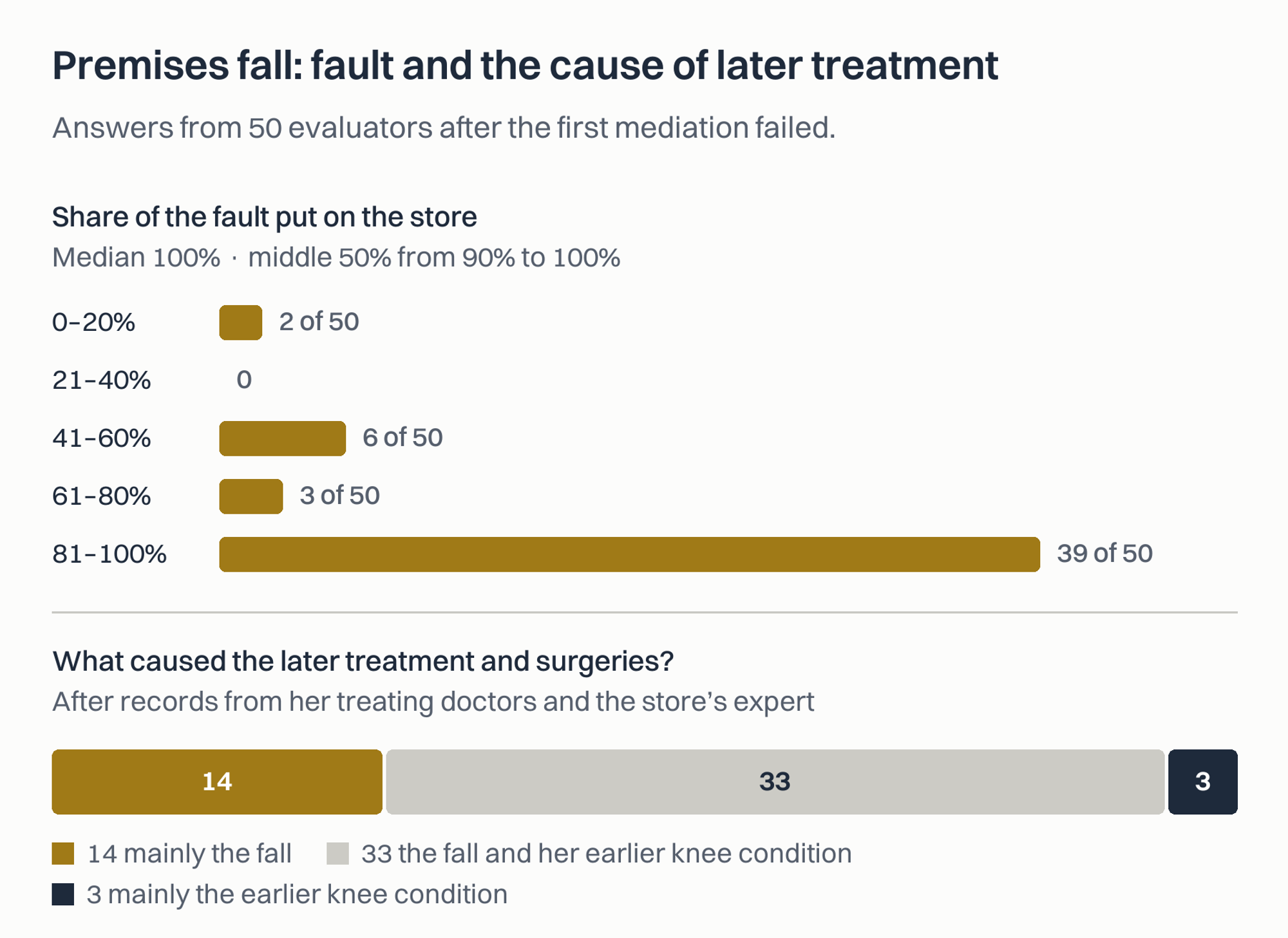
Source: Focus’s records, 50 evaluators who finished the panel, checked November 24, 2026.
On fault the panel was nearly one-sided. Of 50 evaluators, 39 put 81–100% of the fault on the store, the median was 100%, and only 2 put 20% or less on it. Written explanations cited the store’s knowledge of the leak and its failure to warn customers.
On causation the panel was not one-sided. Thirty-three said both the fall and the knee condition contributed, 14 said mainly the fall and 3 said mainly the knee. In their written explanations, 17 of 50 evaluators mentioned the pre-existing condition and 7 described her as improving until the fall set her back. Six were openly skeptical; one wrote that the claim “seems like a cash grab.”
Leaving out three first awards entered as $1.50, $100 and $258, 24 of the other 47 evaluators raised their award after seeing the billed and paid amounts, 18 kept it and 5 lowered it. Their median stayed at $500,000, and the lower end of their middle 50% rose from $125,000 to $275,000, so the $115,000 offer sat below it both before and after. The final awards from all 50 evaluators had a median of $500,000, with 18 at $1,000,000 or more.
The three evaluators who first entered $1.50, $100 and $258 gave final awards of $45,000,000, $110,000 and $58,888, so their first amounts are left out of the before-and-after comparison. Counting every amount as entered, as Focus’s report does, the lower end of the middle 50% rose from $56,250 to $250,000, and the offer sat inside the first middle 50% and below the final one.
What it means for each side
For plaintiff counsel, the $115,000 offer was hard to defend on fault, and the awards held up after the paid amounts were disclosed.
For the store, the knee condition gave the parties a narrower question. Thirty-three of 50 said both the fall and the earlier condition contributed to her later treatment. The parties could negotiate the setback and the prospect of future surgery and therapy without first agreeing on everything else.
What happened next
When this post was first published, the parties were preparing for a second mediation.
Surgery after treatment gaps: testing medical causation
The challenge
After a lane-merge collision, the plaintiff eventually had a meniscus repair, cervical spine surgery and lumbar spine surgery. The defense read the delays in her care and the lack of early imaging as reasons to doubt that the collision caused the need for surgery.
What the evaluators were asked
Twenty evaluators gave an award for all of her damages. They then said how they read the treatment timeline and named the single biggest piece of evidence, or missing evidence, that affected their view.
What the results showed
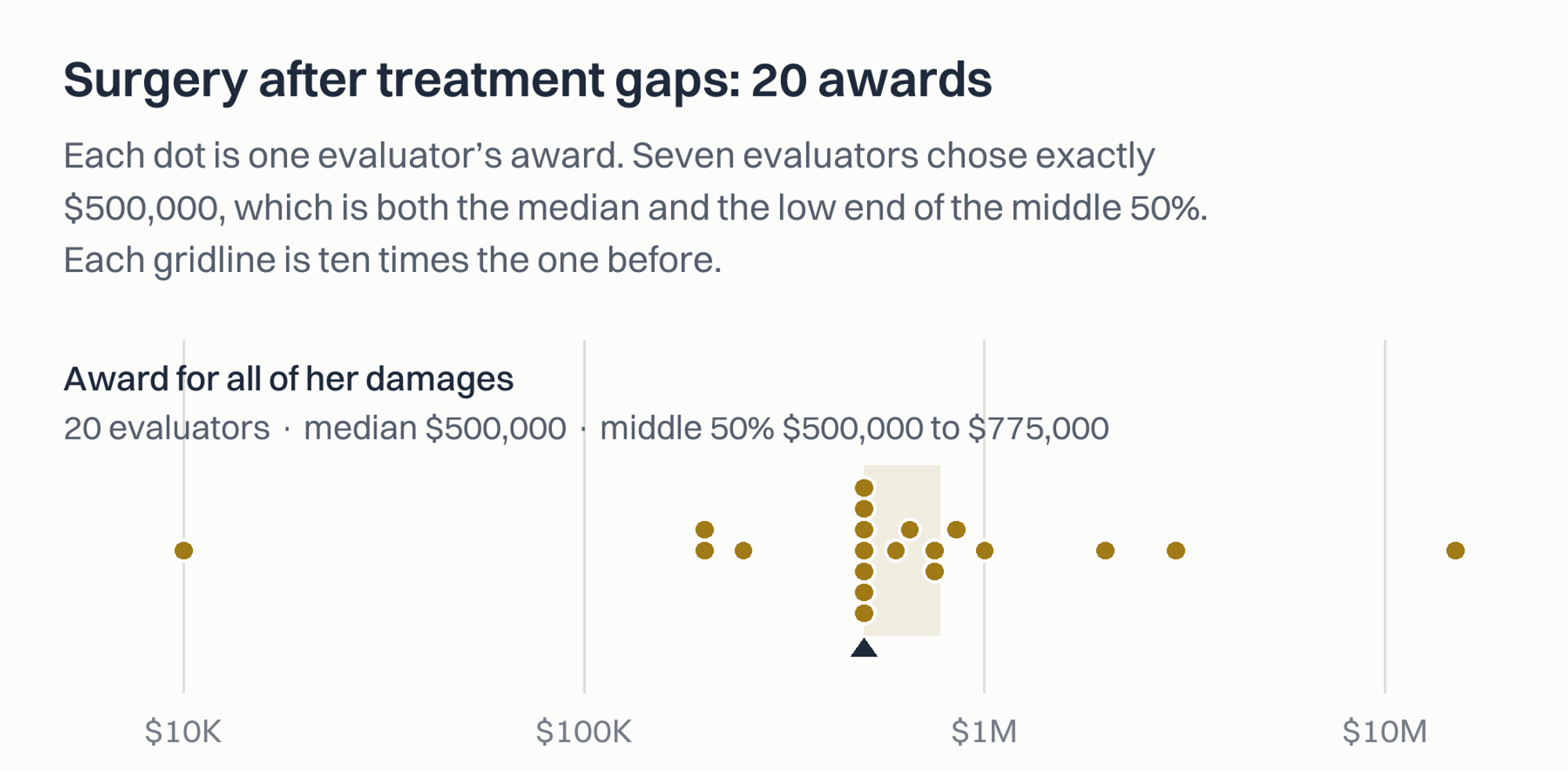
Source: Focus’s records, 20 evaluators who finished the panel, checked November 24, 2026.
Seven evaluators independently chose $500,000, which made it both the median and the lower end of the middle 50%. The middle 50% ran to $775,000. Four evaluators gave $1,000,000 or more, and the adjusted mean was $616,125.
The timeline divided the panel. Of 19 written answers analyzed, 5 treated the gap as a reason for doubt and 3 asked why she had waited. Others read the same history differently: 6 described her as seeking care consistently, 4 said symptoms can appear late and 4 saw access to doctors as an explanation. Asked for the single biggest piece of evidence, 7 of 18 named the unsafe merge and 4 named the MRIs and the doctors’ support for the injury. For 3 it was the length of the wait, and 2 named the emergency room notes or gaps in imaging.
What it means for each side
For plaintiff counsel, 7 of 20 evaluators reached the same $500,000 on their own, and only 5 of the 19 timeline answers treated the gap in care as a reason for doubt. Access to care was an evaluator’s interpretation, though. A demand that relies on it still has to show what happened in this patient’s case.
For the carrier, the doubts were real but specific. A more useful exchange before settlement would identify which procedure the carrier disputes, what is missing from the early records, and what the later imaging and the treating doctor establish about that injury.
Birth injury: the missed test and the timing dispute
The challenge
A full-term newborn was extremely pale at birth. The obstetrician asked for a complete blood count, or CBC, and the request was not followed. Profound anemia was found hours later, and the child had severe cerebral palsy. The plaintiff’s case was that earlier testing and a transfusion could have prevented the brain injury. The defense’s case was that a hemorrhage long before delivery had already caused it.
What the evaluators were asked
Fifty evaluators said when they thought the injury most likely occurred, whether earlier treatment would have changed it and which plaintiff evidence on timing was most convincing. They said whether the CBC should have been ordered sooner and what share of responsibility the hospital, nurses and neonatal nurse practitioner bore. After reading two life care plan summaries, they gave total damages.
What the results showed
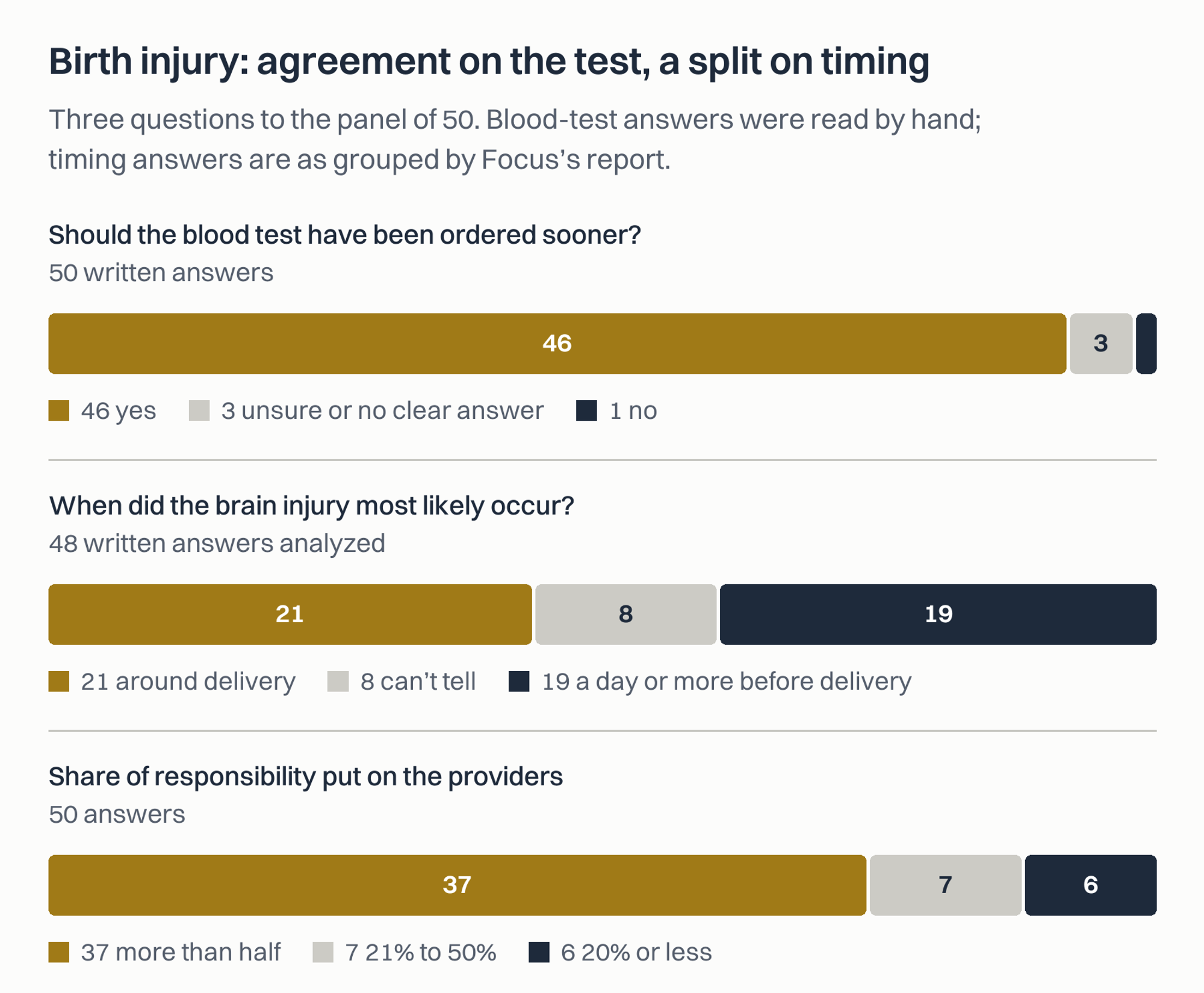
Source: Focus’s records, 50 evaluators who finished the panel, checked November 24, 2026. We read the 50 blood-test answers ourselves. The timing counts are the themes in Focus’s report, which analyzed 48 answers from evaluators who finished.
On the test, the panel nearly agreed: 46 of 50 said yes outright. On timing, it split. Of 48 timing answers, 21 placed the injury shortly before or around delivery, 19 placed it a day or more earlier, as the defense argued, and 8 could not tell. In 48 answers about whether earlier treatment would have helped, 27 said the injury would have been avoided or reduced and 5 said it possibly could have been reduced, while 11 were unsure because of the timing and 3 said the damage was already done. One answer can carry more than one of these themes.
Asked for the most convincing plaintiff evidence on timing, 18 of 48 cited the unfulfilled order for the blood count, 13 the baby’s pallor and blood findings at birth, and 11 the experts’ opinions. Evaluators cited the missed test more often than the expert opinions, even on a question about timing.
Even with timing unresolved, 37 of 50 put more than half the responsibility on the providers, and 6 put 20% or less on them. After the life care plans, the median total damages were $13,500,000. The middle 50% ran from $5,500,000 to about $22,500,000.
What it means for each side
For plaintiff counsel, the missed test was the point the panel agreed on: 46 of 50 said it should have been ordered sooner, and it was cited more often than the experts’ opinions even on the question about timing. For the defense, the panel gave real support on causation: 19 accepted the earlier-injury theory, and 11 were unsure whether earlier treatment would have mattered. Those are different questions. A mediator who sees both answers can discuss the exposure without assuming either side must first win the timing dispute.
What happened next
When this post was first published, the case was set for mediation.
Testing evidence in stages
Four times across three of these panels, evaluators answered the damages question, saw new evidence and answered again. Because the same people answered each time, the change can be counted evaluator by evaluator rather than inferred from two different groups.
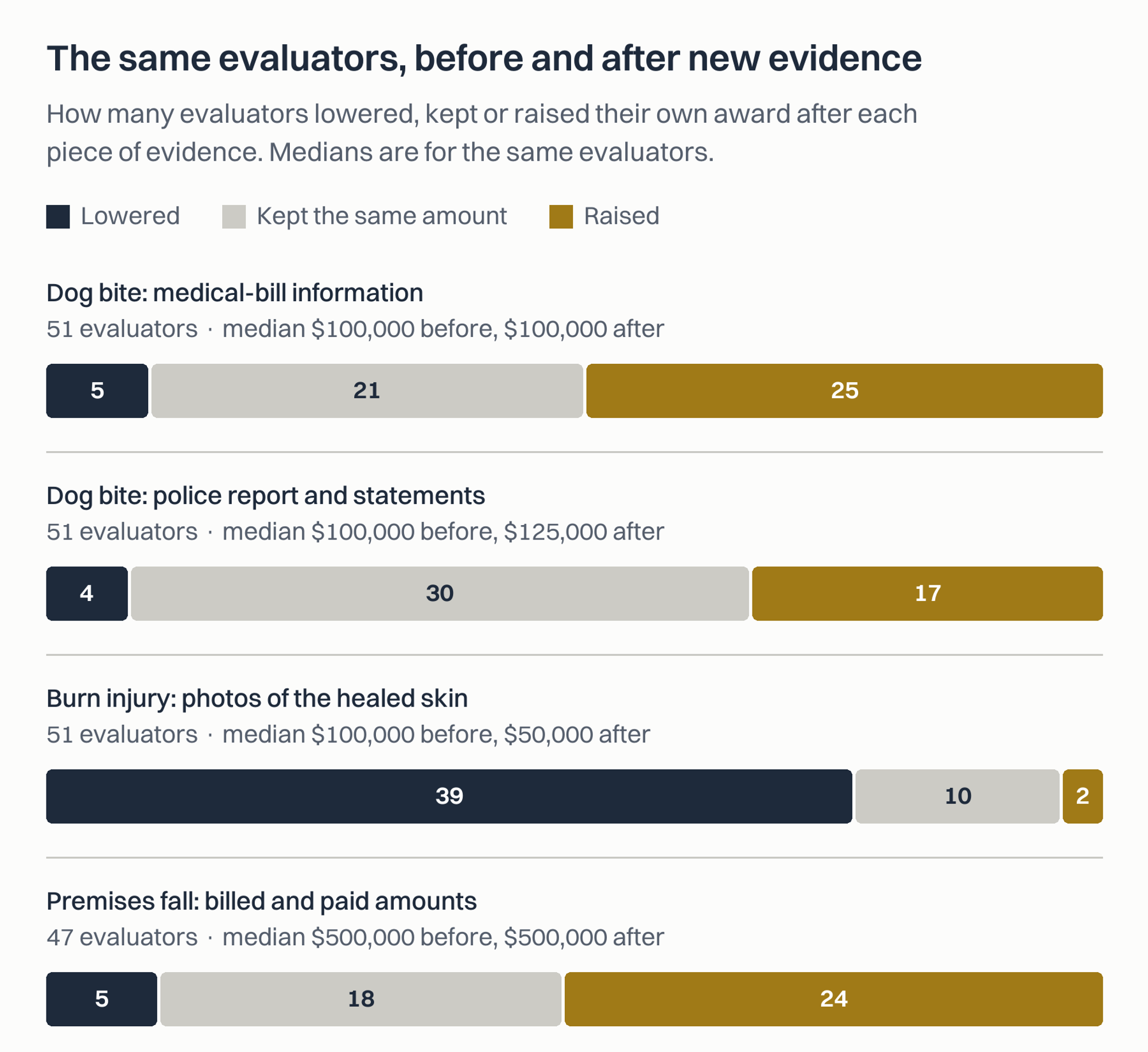
Source: Focus’s records, checked November 24, 2026. Both dog bite rows use the same 51 evaluators. Four entered $0 on the revised-award question and said their award was unchanged, so their first amount is carried forward. The burn row includes all 51 evaluators and the premises row 47 of 50, leaving out three first awards entered as $1.50, $100 and $258.
Awards moved in both directions. After photographs of healed skin, 39 of 51 evaluators lowered their award. After the police report about the dog’s owner, 17 raised theirs and 4 lowered it. A carrier has as much use for a result like the burn case as plaintiff counsel does, and a method that shows awards falling is more credible when it also shows them rising.
The medical-bill information is where an assumption would have misled. In both the dog bite and the premises cases, evaluators learned that the amount paid was lower than the amount billed. A defense might expect that disclosure to bring awards down. In both panels more evaluators raised their award than lowered it: 25 against 5 in the dog bite case, and 24 against 5 in the premises case. Two panels do not make a general rule, but neither supports the assumption.
How evaluators respond to a piece of evidence does not have to be assumed. It can be tested by asking for an award before the evidence and again after it. The first answer is what makes the second one useful. Without it, either side could credit a final number to the evidence when evaluators had already reached it on other grounds.
The limits still apply. Answering a second time may change an answer by itself, and evidence shown later is seen by people who already know the rest of the case.
What the seven cases had in common
- Documents gave evaluators reasons. A police report, a record of 82 replaced skylights and the treating doctors’ records gave evaluators something specific to cite.
- Photographs and video cut both ways. After photos of healed skin, the burn panel’s median award was half as high. In the gas station case, evaluators drew opposite conclusions about fault from the same video.
- Evaluators focused on decisions they could judge. In the birth injury case they cited the missed blood test more often than the expert opinions.
- Offers and demands can both be tested. The highway and premises panels set a $0 offer and a $115,000 offer against how evaluators divided fault and valued the damages. The burn panel showed how much lower the awards were once evaluators saw the healed photos, which a demand built on the early photographs would have missed.
The written answers add a caution to each of those. The evidence that mattered depended on the question evaluators were answering. In the gas station case, the video showed a warning and left open how long the store had known about the water. In the highway collision, the footage supported a failure to yield and also gave some evaluators a reason to credit the speeding theory. Sending the other side the video alone leaves it free to see what it saw the first time. The written answers identify the competing readings the parties need to address.
Using the results: demand, reserve, mediation or trial
Start with the issue keeping the parties apart. If it is liability, ask evaluators how they would divide fault and why, as in the highway and premises cases. If it is damages, compare the offer or the demand with the panel’s median and middle 50% of awards, as in the dog bite and gas station cases. If one exhibit could change the number, ask for an award before and after evaluators see it, as in the burn case. How to run an online focus group covers setting one up.
Ask why, not only how much. In the surgery case, asking only for an award would have produced the $500,000 median. Asking how evaluators read the timeline also showed which gaps needed an explanation.
The same results serve different decisions. Plaintiff counsel can use them to set and support a demand. A carrier or defense counsel can use them to set a reserve, judge whether an offer matches the exposure, or decide which defense argument is worth developing. Before mediation, bring the mediator the offer, the median, the middle 50% of awards and the explanation from the part of the panel that agreed with the other side. In preparing for trial, the written answers show which evidence people found convincing and which arguments they did not credit.
Say whether awards were entered before a reduction for fault and whether the question supplied a dollar figure. That keeps the discussion on the actual difference between the parties, whether it is notice of a leak, the cause of a surgery or the effect of a missed test.
Better evidence for litigation decisions
Across these seven cases, the panels showed things a single estimate of case value could not. Evaluators identified weaknesses on both sides, read the same evidence in competing ways and changed their awards as new evidence arrived. Some results challenged the defense’s valuation. Others identified problems plaintiff counsel had to address.
Testing a case does not remove the uncertainty in litigation. It replaces some assumptions with measurements from people who live where the case would be tried.
Whether you are preparing a demand, evaluating a claim, setting a reserve, preparing for mediation or developing a trial strategy, Focus gives you independent feedback from your venue. See how Focus works for attorneys and for insurers, look at pricing, or book a 30-minute demo to see what a panel could show about your next case.
Updated November 24, 2026: added the before-and-after awards from three panels, the written-answer themes from all seven, charts of the results and what each result means for both sides. Outcomes are as counsel reported them when this post was first published.
Note: These examples are case-specific and presented for educational and informational purposes. Outcomes vary by jurisdiction, facts, evidence quality and counsel strategy. Focus group feedback is not a guarantee of any trial or settlement result.
Notes
- Patricia Munch Danzon and Lee A. Lillard, “Settlement Out of Court: The Disposition of Medical Malpractice Claims,” Journal of Legal Studies 12 (1983): 345. Of the malpractice claims they studied, fewer than 10 percent were tried to verdict, and the authors estimate that settled cases paid, on average, 74 percent of their potential verdict (pp. 347, 365). PDF. ↩︎