
Monday, November 23, 2026
Peer Influence: How Evaluators Respond to Competing Perspectives

In this post
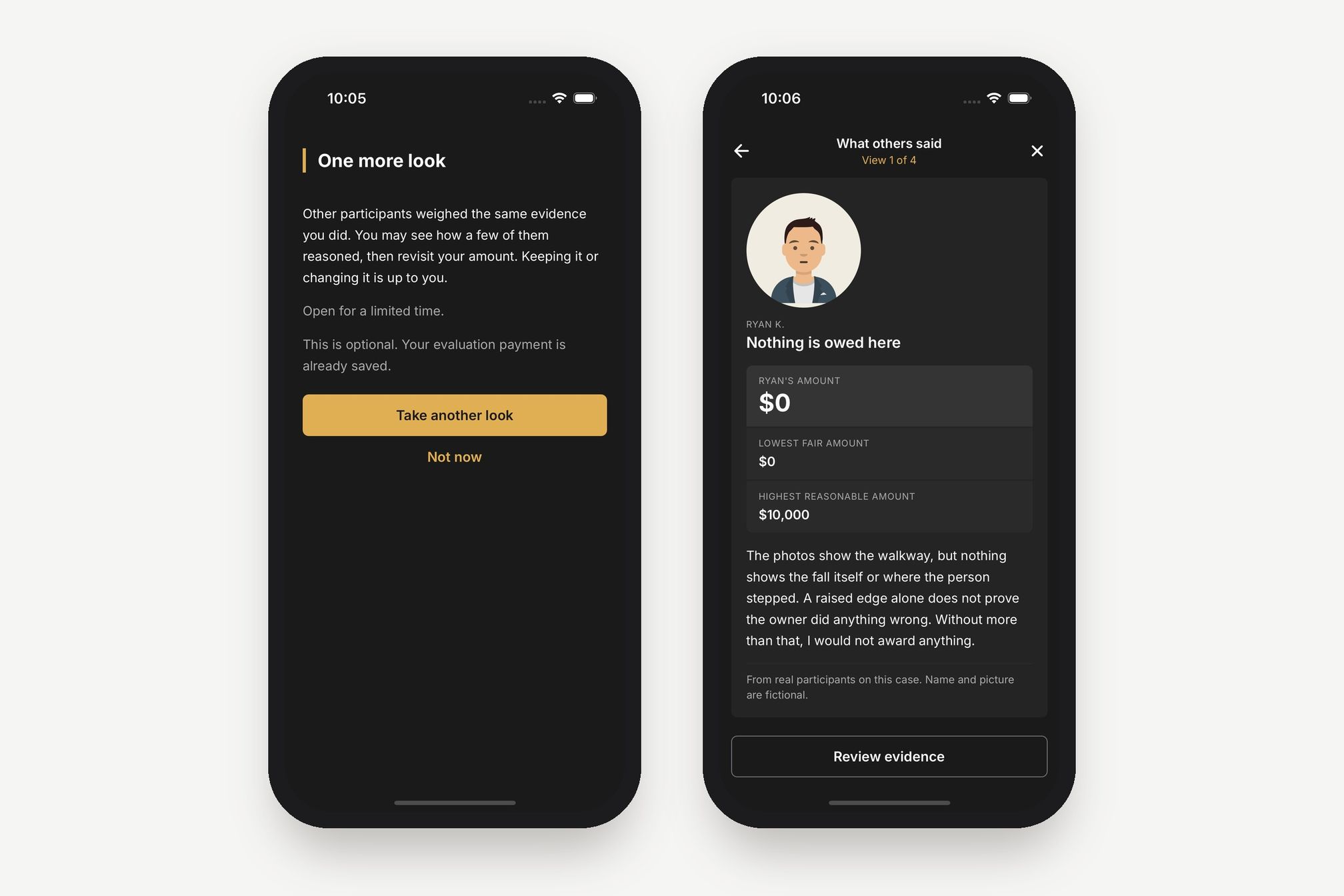
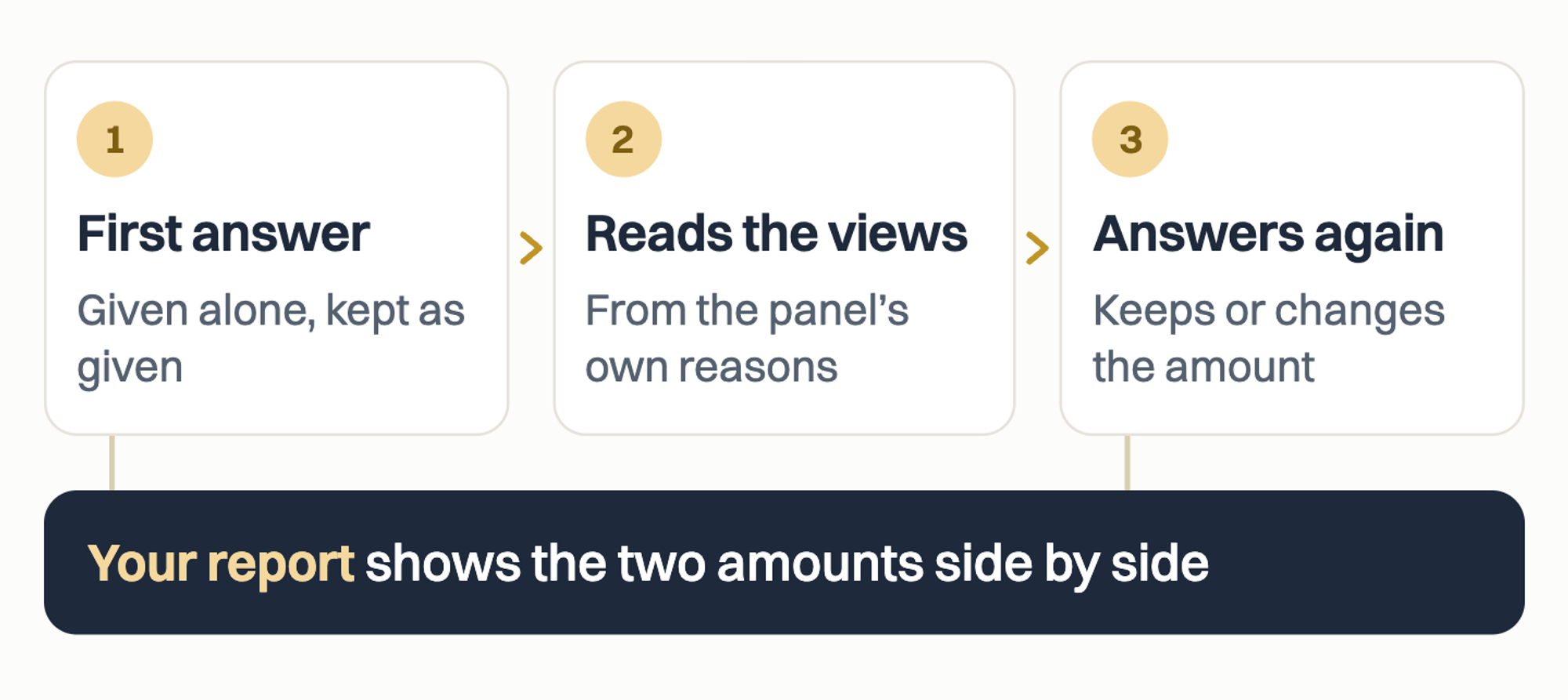
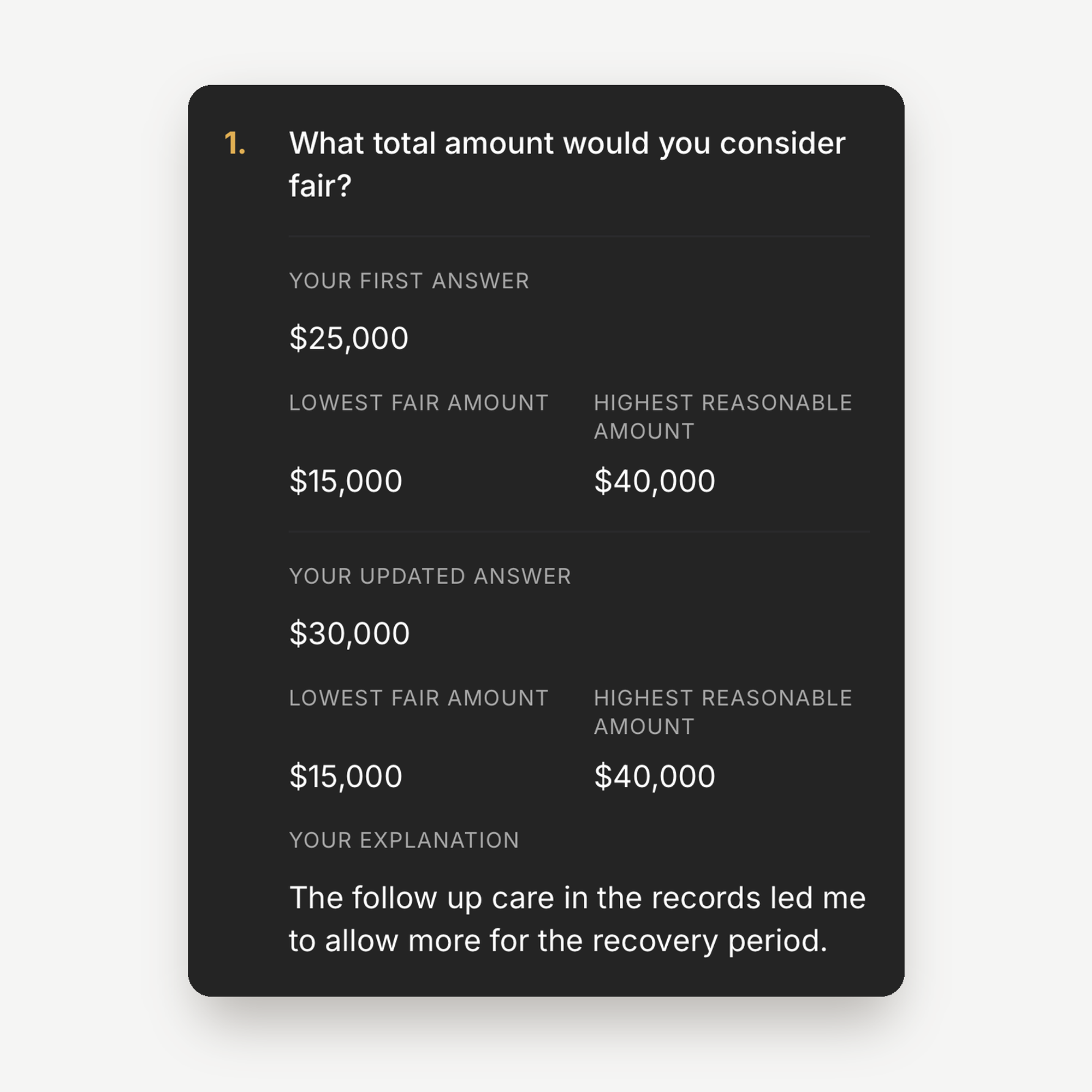
A first answer tells you how someone reads the evidence on their own. Peer Influence tells you whether that answer holds when they read how others on the same panel saw the case differently. Focus keeps each evaluator’s original answers. On eligible cases, evaluators can then take an optional follow-up: they read a few views written from the panel’s own reasons, answer again and say which view, if any, mattered most. On award cases, your report shows each evaluator’s first and follow-up amounts side by side, so you can see which amounts held and which moved, and how far.
What you learn from it
- Which amounts hold. You can see which evaluators gave the same amount after reading views that argued for much less or much more.
- Where the award is sensitive. The report shows each change, its direction and its size. A median can stay put while several people move a long way.
- Which reasons registered. The app asks which view mattered most, including when an evaluator kept their amount, and the report tallies the answers.
Asking people one at a time gives you independent judgments. Peer Influence adds a second answer from the same people. Each evaluator answers alone, reads views prepared from the panel’s earlier answers, and then answers again, so you can compare the two answers person by person.
How the follow-up works
After evaluators submit, their answers are kept as given. On eligible cases, evaluators who completed a paid evaluation can take an optional step called One more look once the views are ready and while the step is open. Everyone who takes it reads the views.
Each view is a short first-person account written from reasons evaluators on the panel gave in their own words. Each has a fictional name and an illustration, and the report gives the number of evaluators whose writing contributed to it. A view’s text never states an amount. On award cases, the amount beside a view is one contributing evaluator’s original amount, rounded, with their fair range if they gave one.
Before evaluators see the views, Focus checks each one automatically against the answers it draws on. It screens for points those evaluators didn’t make, facts that aren’t in the case material, wording stronger than the most certain of them, stated dollar amounts, directions to the reader and identifying details such as an email address or phone number. A view that fails may be rewritten and checked again. Only a version that passes is shown.
After reading the views, evaluators return to the case’s main award question. They see their first amount and can keep it or change it. If they change it, they explain how they arrived at the new figure. If the first question didn’t collect a fair range, the follow-up asks for one. On a case with no award question, evaluators write what they think now. After they submit, the app asks which view, if any, mattered most. None and Not sure are both choices.
An example
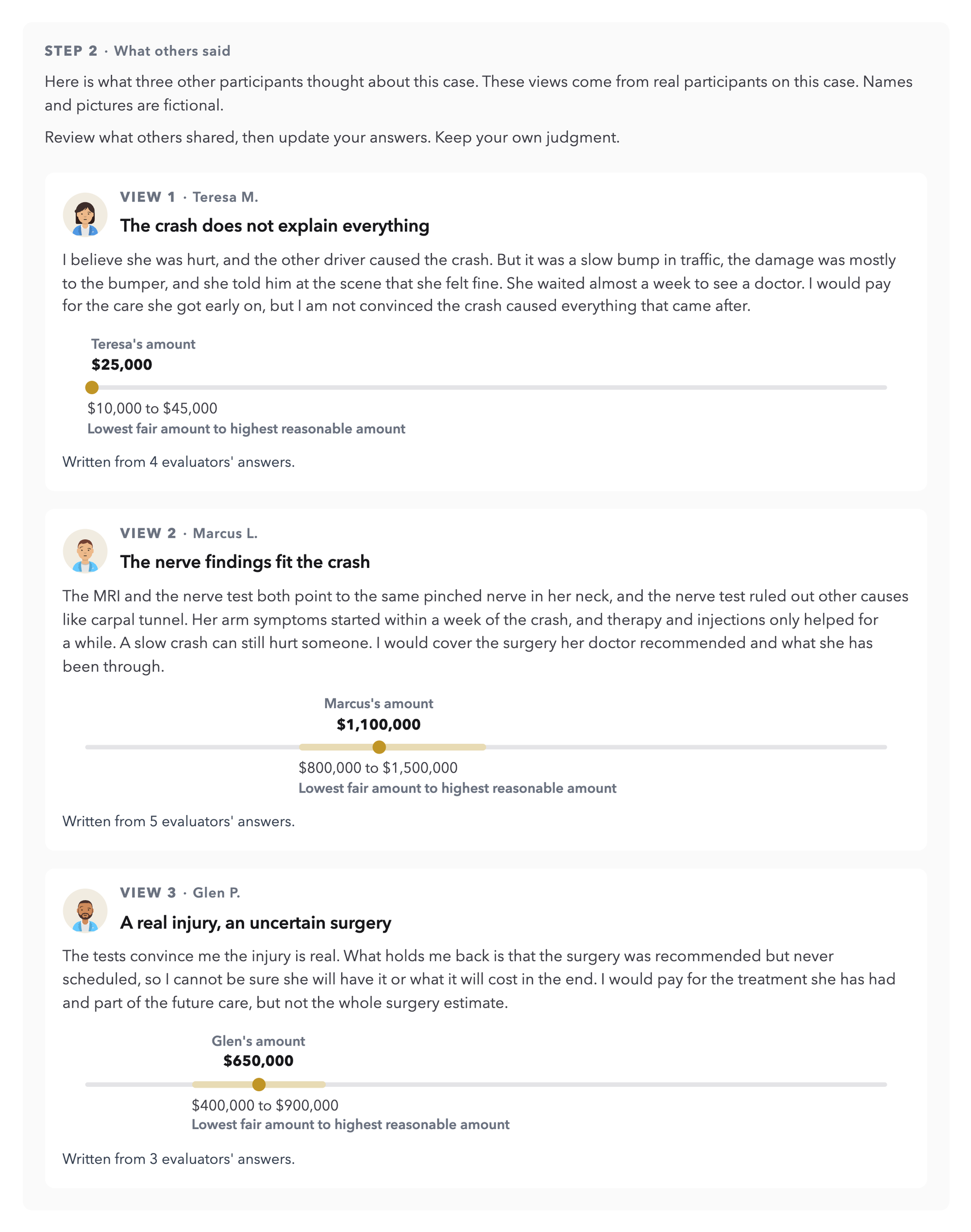
This example uses the sample case from the product guide: a low-speed rear-end crash, an MRI and a nerve test that support a pinched nerve in the injured driver’s neck, and a recommended fusion that hasn’t been scheduled. The Peer Influence results are illustrative, not results from a real case.
Evaluators read three views. One argued that the crash doesn’t explain the whole medical course, one that the nerve findings fit the crash, and one that the injury is real but the surgery uncertain. The amounts shown beside the three views ran from $25,000 to $1,100,000.
What changed
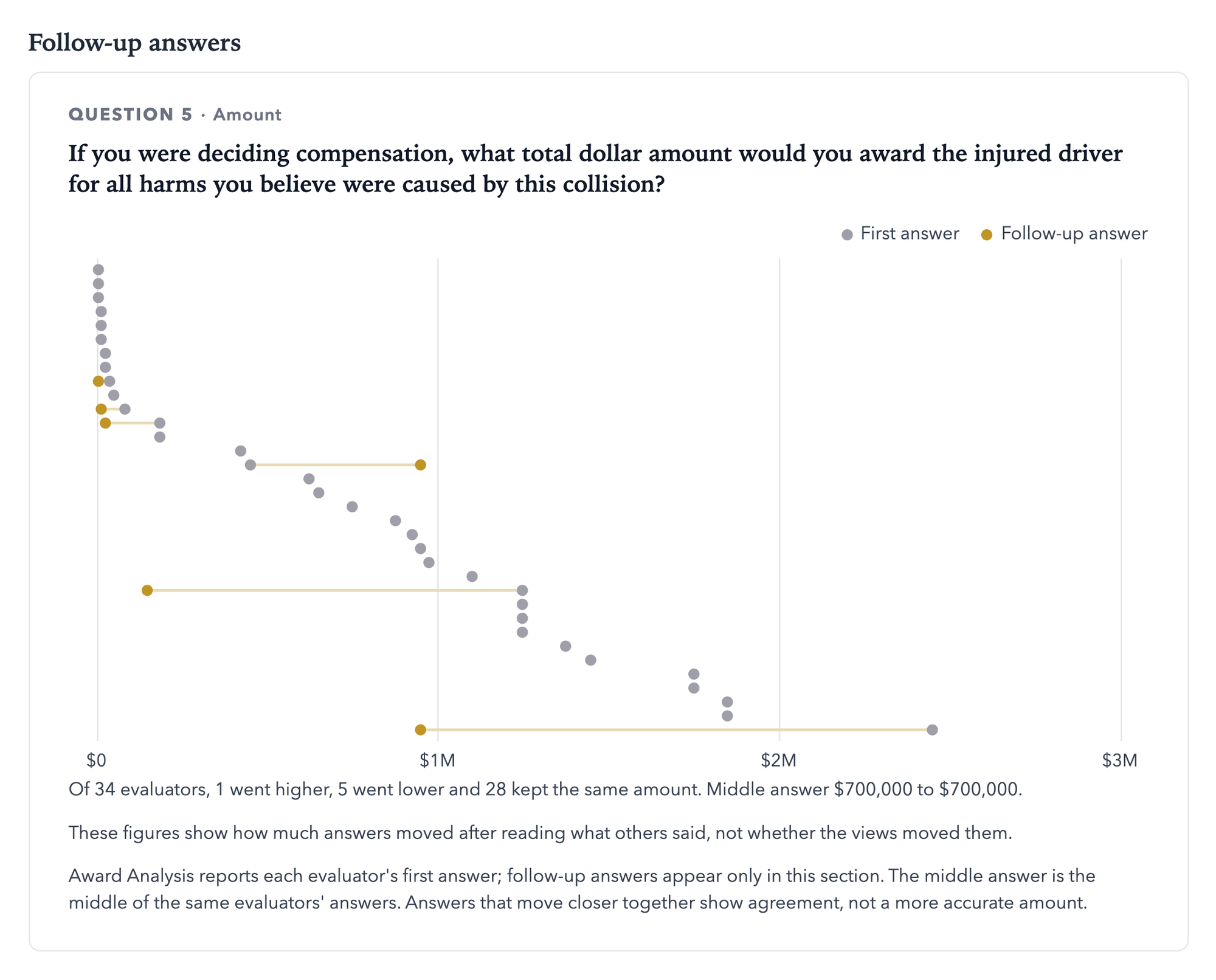
| Paired answers in the example | Result |
|---|---|
| Evaluators who gave both amounts | 34 |
| Kept their first amount | 28 |
| Lowered it | 5 |
| Raised it | 1 |
| Median first amount | $700,000 |
| Median follow-up amount | $700,000 |
Source: an illustrative Focus report on the sample case, checked November 24, 2026. It includes the 34 evaluators who gave both award amounts. These are not results from a real case.
The median didn’t move. Behind it, six of the 34 evaluators changed their amount. Five lowered it, four of them by more than 80 percent; one went from $1,250,000 to $150,000. One raised theirs from $450,000 to $950,000. The other 28 gave the same amount after reading the three views.
For a mediation, that’s the finding: of the 34 evaluators who gave both amounts, 28 repeated their first figure, and five of the six changes were decreases, four of them cuts of more than 80 percent. The median alone would show none of that.
Which views mattered
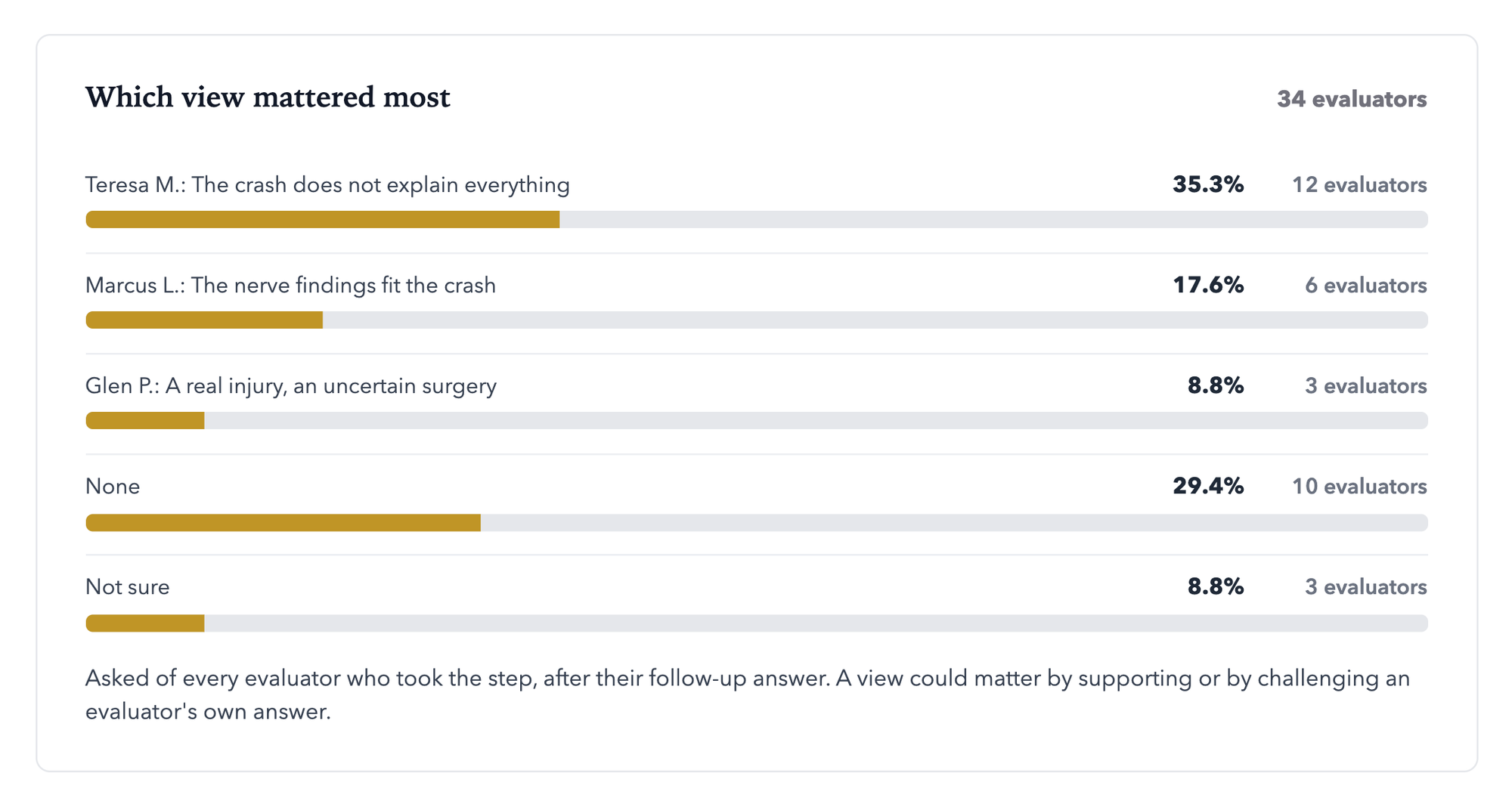
| Which view mattered most | Evaluators |
|---|---|
| Teresa M.: The crash does not explain everything | 12 |
| Marcus L.: The nerve findings fit the crash | 6 |
| Glen P.: A real injury, an uncertain surgery | 3 |
| None | 10 |
| Not sure | 3 |
Source: the same illustrative Focus report, checked November 24, 2026. 34 evaluators answered this question.
Twelve evaluators chose the view that the crash doesn’t explain the whole medical course, twice as many as chose the nerve findings. Ten chose None. A view can matter because it challenged someone’s answer or because it confirmed it, so read the choices as the reasons that registered with the panel, not as the reason a given amount changed. Before mediation, be ready to explain how the records connect the crash to the later care. Twelve evaluators chose the view that questioned that connection.
What Peer Influence measures
Peer Influence records answers before and after evaluators read other views. It shows how judgments changed, not what caused each change: someone might also revise an amount simply because they were asked again. It doesn’t predict how a jury would deliberate or decide. The paired chart needs at least five evaluators who gave both amounts, and its two medians describe those same people, even if more evaluators answered the original question. Award Analysis and the rest of the report use the original answers.
Eligible cases
Peer Influence is available on eligible Gold, Platinum and Elite cases with at least one Freeform question. The written answers supply the material for the views. The step stays open for a limited time after the panel fills. When it closes and the case has Peer Influence results, you get an email that the full report is ready. In the completed report, the paired chart and the final question have separate counts, and the final-question tally appears once at least five evaluators have answered it. You can switch off Peer Influence in the version you share with a mediator and keep it in the copy for your team.
More than the first answer
What evaluators think on their own is the starting point. Peer Influence adds a second answer from the same people after they read competing views: which amounts stayed, which moved and how far, and which views they said mattered to them. Read it with Award Analysis, Qualitative Insights and Trial Analysis before you set a demand or answer an offer. See plans and pricing for the tiers.