
Monday, November 23, 2026
Legal Focus Group Questions: Examples, Best Practices, and Research Strategies

In this post
Start your legal focus group questions with the decision you need to make: a demand, a response to an offer, a reserve or whether to try the case. If fault and damages are both disputed, ask each evaluator to divide responsibility and to enter total damages before any deduction for fault. Then ask a written question immediately after the answer you most need to understand. A fault split tells you how someone divides responsibility. Their explanation can tell you which part of the video you’ll need to address at mediation.
Start with the decisions you need to make
A legal focus group begins with a research objective. You may want to test a liability argument, learn how people read the medical evidence, value the damages or find out which facts carry the most weight. Each objective calls for different questions, and the example sets below are organized that way.
You don’t have to write the questions from a blank page. With Focus Intelligence, you upload your case files and Focus reads them. It then proposes a focus group strategy: findings on liability, damages, witness consistency and gaps in discovery, reactions evaluators may have, and the strengths and weaknesses of each side, with citations to your files. You decide which items to test and which to keep as context only. When you approve the strategy, Focus drafts the parties, case facts and questions, and you can change any of them in Set Up before you publish. How to run an online focus group walks through each step.
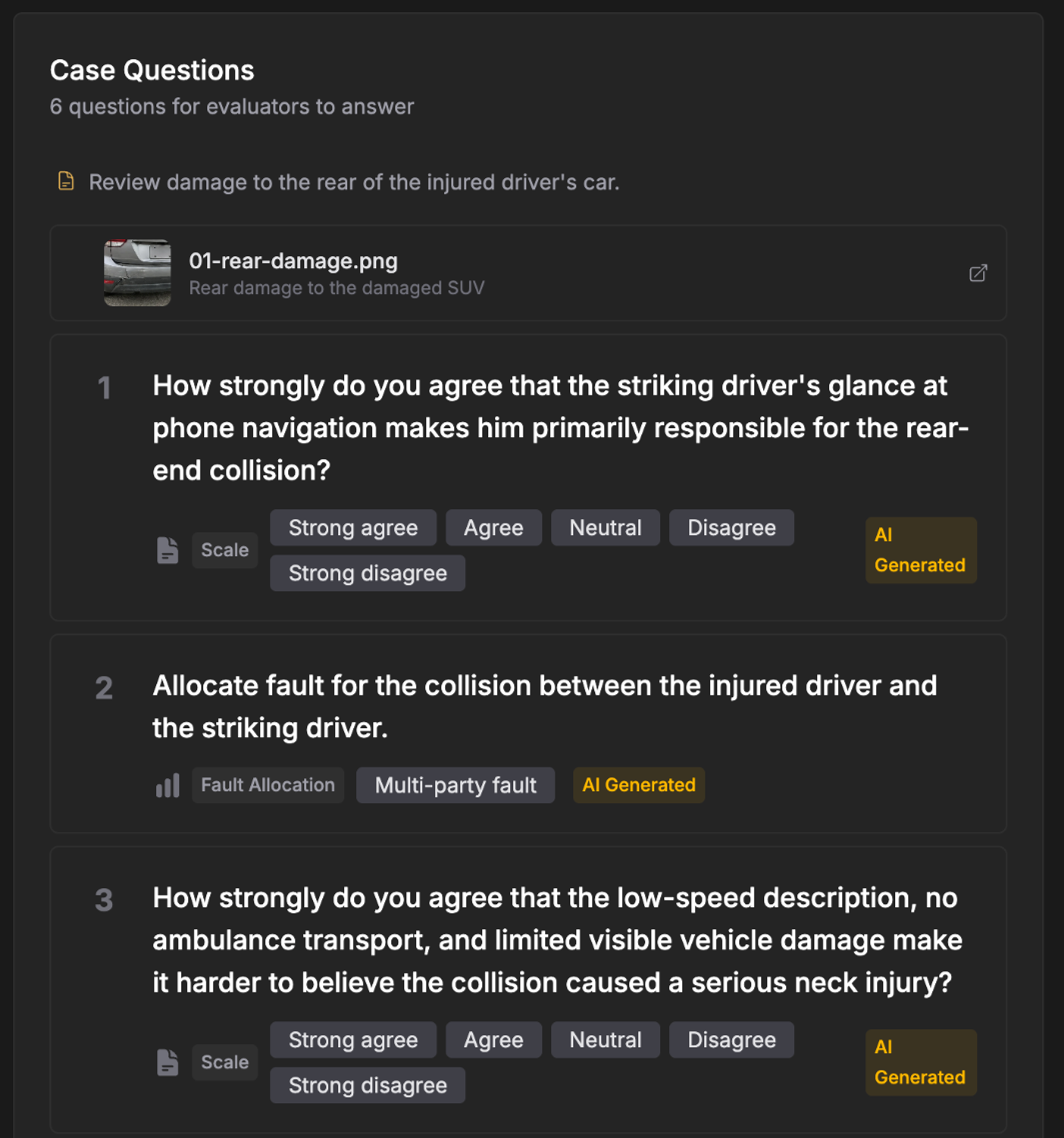
The rest of this guide explains what each kind of question tells you, so you can judge a draft, change it or write your own.
Ask why right after a decision
Where should a written question go? We looked at 54 cases with at least ten completed evaluations, from 26 firms and insurers, not counting our own test cases. When a written question asked why immediately after a decision, evaluators wrote longer answers, and very short answers were about a third as common.
Focus research · 54 cases
- median characters per answer when the question asked why immediately after a decision, against 129 for other written questions
- 197
- of those answers were under 40 characters, against 18.5% for other written questions
- 6.1%
- written answers from completed evaluations, from 26 firms and insurers
- 4,479
Source: Focus records, checked November 24, 2026, counting answers from completed evaluations only. Asked why immediately after a decision: 1,270 answers to 28 questions in 23 cases. Other written questions: 3,209 answers to 64 questions in 33 cases. A decision was an Amount, Fault Allocation, Scale, Percentage or Ranking answer. We put a written question in the first group when it came immediately after one of those questions and its wording asked the evaluator to explain the answer or name what influenced it, found by searching for phrases such as “explain,” “why you” and “most influenced.” All other written questions went in the second group. The first median is 196.5 characters, shown rounded.
These are observations, not an experiment. The two groups contain different questions, some cases contributed to both, and a long answer isn’t necessarily a useful one. To judge whether an answer helps the negotiation, look for the fact the evaluator relied on. Qualitative Insights groups written answers by theme and counts the evaluators who raised each theme. Include the relevant questions in the Raw Responses Appendix to read each explanation beside the award or fault split it explains.
Question sets by research objective
The question type decides what you can take back to the other side. An Amount question gives you dollar figures. Fault Allocation lets you apply each evaluator’s split to that same person’s award. Freeform gives you the reasons behind the numbers. Scale, Percentage and Ranking answer narrower questions: which explanation of an injury people accept, how much of a claimed loss they allow and which facts carry the most weight.
Each set below lists questions in the order evaluators would answer them. The standard limits are three questions on Silver, six on Gold and twelve on Platinum. On Elite the number is set per case. With three questions, use the first three of a set. Focus plans and pricing
Valuing the damages
A driver was hurt in a crash, and the need for a future surgery is disputed.
- Amount, with a fair range: “What total amount would fairly compensate the driver for the harm caused by the crash? Include any future care you think the crash made necessary.”
- Freeform: “What in the evidence most affected that amount, and why?”
- Amount: “Of that total, how much did you include for the proposed surgery? Enter $0 if you included nothing.”
- Ranking: “Which parts of the harm weighed most in your amount?” Past medical bills, future care, lost earnings, and pain and limits on daily life.
- Scale, shown after the amounts: “If the driver asked for $750,000, would that amount feel too high, about right or too low?”
- Freeform: “What record, witness account or photograph, if any, would you want to see before deciding?”
What you learn: a typical award and the range people consider fair, how much of it rests on the disputed surgery, and how your demand compares with the amounts people chose on their own.
Testing liability and comparative fault
A customer fell at the edge of a store’s walkway.
- Fault Allocation: “Divide responsibility for the fall between the store and the customer. You can give either one 0%.”
- Freeform: “Which fact mattered most when you divided responsibility, and why?”
- Amount: “What total amount would fairly compensate the customer for the fall, before any deduction for fault?”
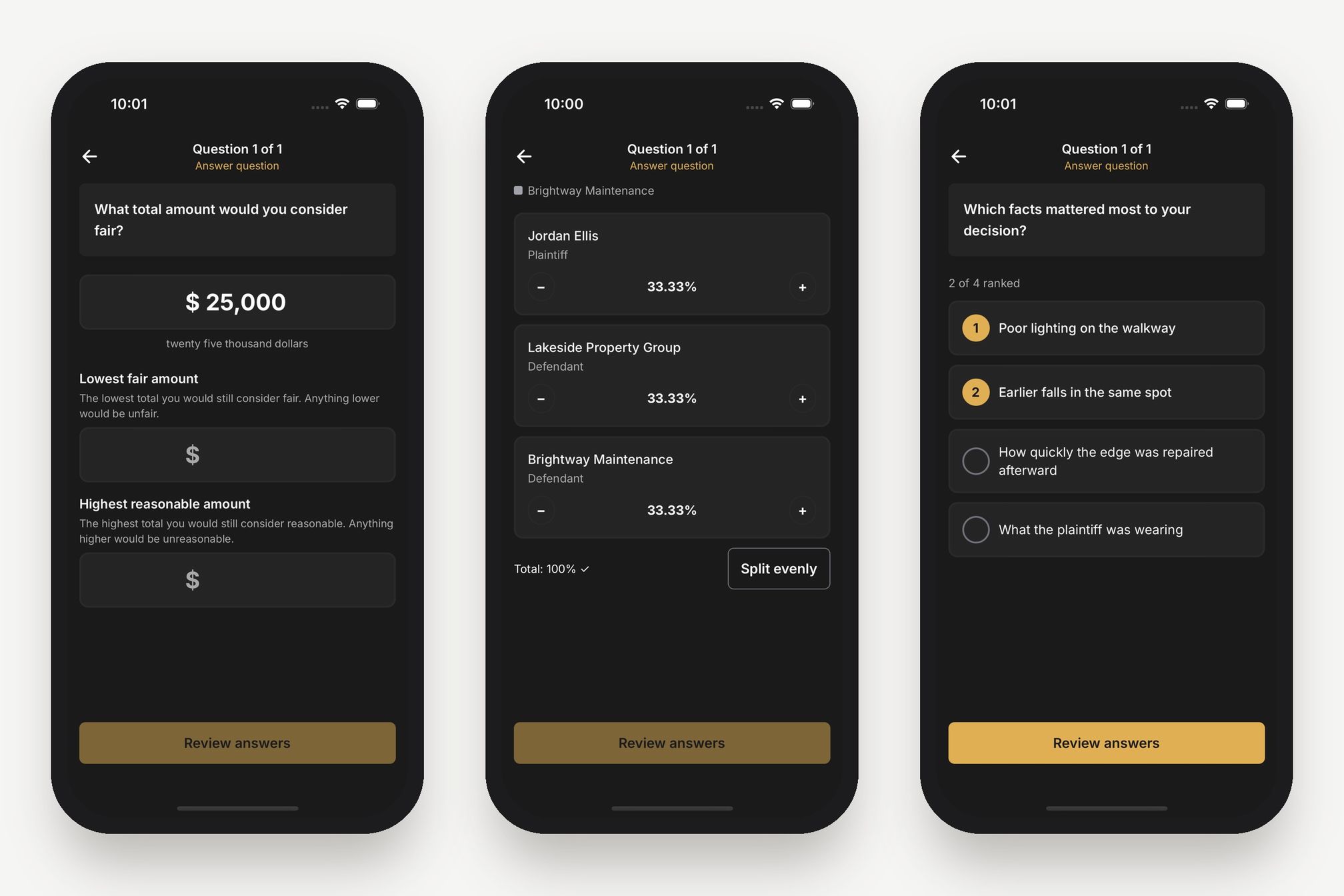
- Ranking: “Which facts mattered most to your decision?” The lighting on the walkway, reports of earlier falls at that spot, the condition of the walkway edge and the customer’s footwear.
- Scale: “How much weight would you give the store manager’s account of the inspection?” From very heavy weight to none.
- Freeform: “What evidence, if any, would you still want before deciding?”
What you learn: Fault Distribution shows how people divided responsibility. With questions 1 and 3 answered by the same evaluators, Award Impact applies each evaluator’s split to that person’s own award. Comparative fault in a focus group
Causation and disputed medical evidence
The plaintiff had back trouble before the crash.
- Scale: “Which best describes the effect of the crash on her back?” It caused a new injury. It made an existing condition worse. It did both. It did neither. The evidence is insufficient to tell.
- Freeform: “What in the medical records most affected your answer, and why?”
- Amount: “What total amount would fairly compensate her for the harm you believe the crash caused?”
- Percentage: “What percentage, if any, of her current back trouble do you attribute to the crash?”
- Amount, with a fair range: “What amount, if any, would you include for the recommended surgery?”
- Freeform: “How do you read the records from before the crash and after it together?”
What you learn: how many people accept each causation position, and how the award changes with that view. Someone who doubts the crash caused the whole condition may still attribute the setback to it.
Commercial litigation
A distributor says a supplier’s late deliveries cost it customers. The supplier says the distributor agreed to later dates.
- Scale: “Taking account of any changes the parties agreed to, did the supplier deliver when the contract required?” Yes. No. The evidence is insufficient to tell.
- Freeform: “Which document or witness mattered most to your answer, and why?”
- Amount: “What amount, if any, would you award the distributor for losses you attribute to the timing of the deliveries? Enter $0 if you would award nothing.”
- Percentage: “What percentage, if any, of the distributor’s claimed lost profits do you attribute to the timing of the deliveries?”
- Scale: “How reliable do you find the distributor’s projections of lost profits?” From very reliable to not reliable at all.
- Freeform: “What, if anything, would you want to know about the parties’ dealings before deciding?”
What you learn: whether people think the supplier delivered when the contract required, how much of the claimed loss they attribute to the timing and how reliable they find the projections.
Employment disputes
An employee was dismissed several weeks after complaining about a manager. The employer points to earlier performance problems.
- Scale: “Which of these, if either, do you think played a part in the dismissal?” Only the performance concerns. Only the complaint. Both. Neither. The evidence is insufficient to tell.
- Freeform: “What in the evidence most shaped your answer, and why?”
- Percentage: “What is the chance the employer would have made the same decision if the employee had never complained?”
- Scale: “How much weight would you give the performance reviews written before the complaint?” From very heavy weight to none.
- Amount: “What amount, if any, would fairly compensate the employee for emotional distress? Enter $0 if you would award nothing.”
- Freeform: “What evidence, if any, would you still want before deciding?”
What you learn: which reasons evaluators credit, how likely they think the same dismissal was without the complaint and how much weight they give the earlier reviews.
Insurance claim evaluation
A claims team is setting a reserve or answering a demand on an auto claim with disputed fault and disputed medical bills. Use the names evaluators will see in the evidence.
- Fault Allocation: “Divide responsibility for the collision between the two drivers.”
- Amount, with a fair range: “What total amount would fairly compensate the injured driver, before any deduction for fault?”
- Freeform: “What most affected your amount, and why?”
- Percentage: “What share of the billed medical charges were reasonable and necessary?”
- Scale, shown after the amounts: “The injured driver is asking for $250,000. Is that amount too high, about right or too low?”
- Freeform: “What, if anything, would you want to know before deciding?”
What you learn: the gross award, what each evaluator’s fault split leaves after deduction in Award Impact, how much of the billing people accept and how the demand compares.
Criminal defense
Focus also runs criminal matters, where the sides are prosecution and defense. When you add a question to a criminal case, the available types are Scale, Percentage, Ranking and Freeform. In this example, the charge rests on an eyewitness identification.
- Scale: “Has the prosecution proved the charge beyond a reasonable doubt?” Yes, guilty. No, not guilty.
- Freeform: “Which piece of evidence mattered most to your decision, and why?”
- Scale: “How much weight would you give the eyewitness identification?” From very heavy weight to none.
- Ranking: “Which evidence mattered most to your decision?” The identification, the phone location records, the alibi witness and the store video.
- Percentage: “How sure are you of your decision, from 0% to 100%?”
- Freeform: “What, if anything, did you want to know that the evidence didn’t tell you?”
What you learn: how the evidence reads to people outside the case before plea discussions or trial, which pieces carry it and what they still wanted to know.
Testing evidence in sequence
Some questions are about a single exhibit: the surveillance video, the medical bills, the photographs of a healed burn. To compare answers before and after an exhibit, ask the question, show the exhibit, then ask the same question again in the same words. Two Amount questions show the size of a difference. A Scale question offering raise, lower or keep tells you only its direction. Asking twice can itself affect the second answer, so read the result as a comparison of two submitted answers, not as a controlled test.
In a burn case, the same 51 evaluators gave a median of $100,000 after seeing the early photos and $50,000 after seeing the healed burns as well. The later photos helped counsel account for recovery. Showing only those photos would have left out the months when the injuries were visible. In a premises fall, 50 evaluators gave an amount before and after seeing the billed and paid medical amounts. Leaving out three first entries of $1.50, $100 and $258, 24 of the other 47 raised their award, 18 kept it and 5 lowered it. The lower end of the middle half of their awards rose from $125,000 to $275,000, so the $115,000 defense offer sat below it both before and after. Legal Focus Group Results From 7 Real Injury Cases
The same approach tests a demand. Ask for an amount before evaluators see the demand. Then tell them what the plaintiff is asking for, and ask again or ask whether the request feels too high, about right or too low. Experiments find that the amount requested pulls awards toward it. But real juries, recorded while they deliberated, were skeptical of large pain-and-suffering demands and less moved by them than by figures tied to evidence.1 A focus group shows how evaluators respond to your number on your facts.
Order matters as much as wording. In preview, check when each exhibit and dollar figure first appears. If the demand is in Case Facts, evaluators already know your number when they open the first Amount question. If a later photograph is meant to explain a change, make sure they first see it with the later question.
Evaluators can go back and change earlier answers until they submit. Read the first amount as each evaluator’s final answer to the first question, not as a record of what they entered before seeing the later exhibit. Once evaluators submit, their answers are kept as given. On eligible cases, evaluators can then take an optional follow-up, Peer Influence: they read views drawn from the panel’s own reasons and answer again, and the follow-up is recorded beside the first answer.
Amount
Say whose losses the award covers, over what period and whether to include future care. If you also ask about fault, tell evaluators to enter the full amount before any deduction. For one disputed expense, the question can be narrower: “What amount, if any, would you include for the future surgery? Enter $0 if you would include nothing.” If you ask evaluators to assume the crash caused the condition, the award applies to that assumption. A separate causation question tells you who accepts it.
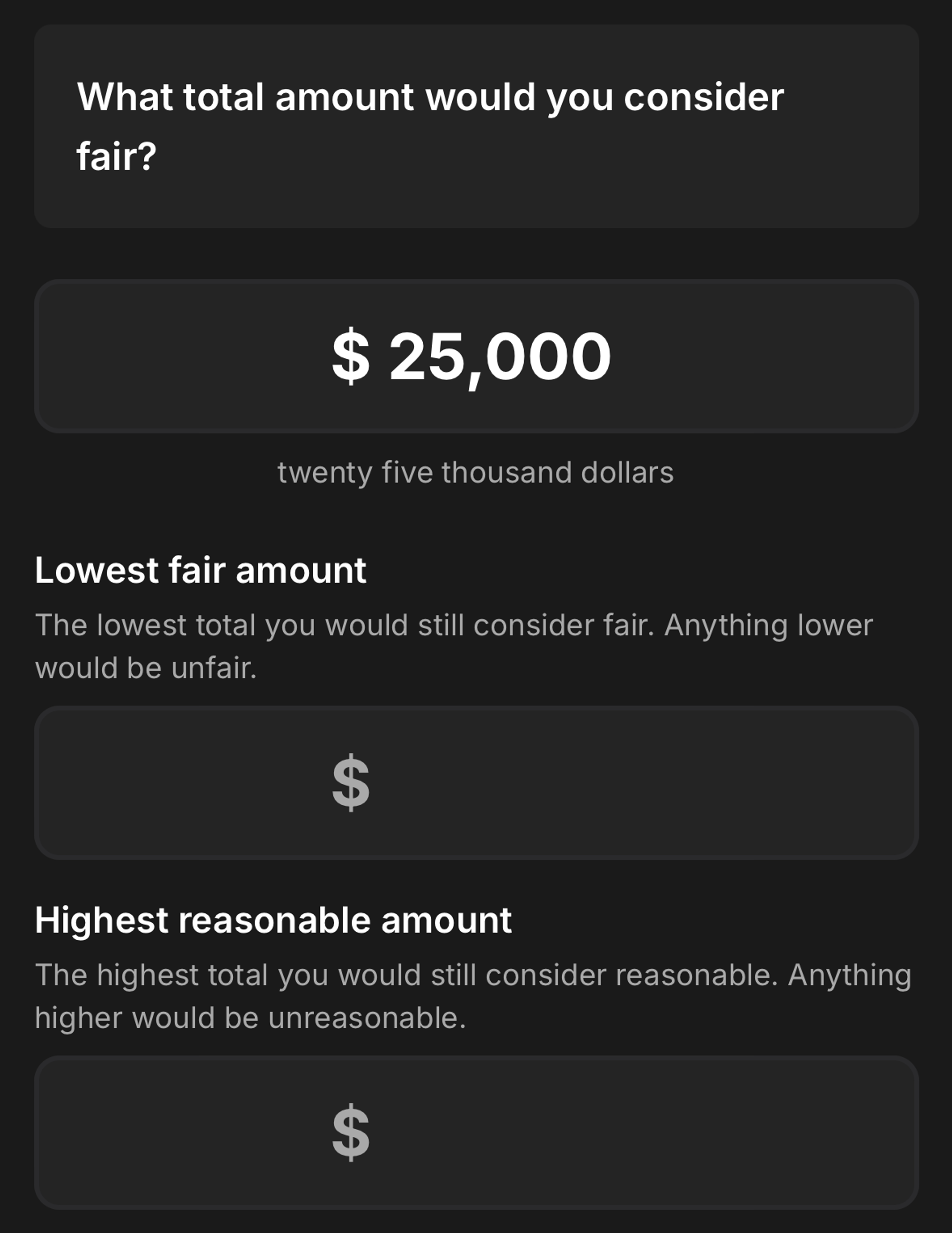
Check Collect a fair range if you want the lowest total each person considers fair and the highest they consider reasonable. It may already be selected. Each Amount question gets its own Award Analysis. If you ask more than one, choose the headline award that appears on case cards and the dashboard. How to read focus group award numbers
More ways to ask:
- One piece of the award at a time. Use separate Amount questions for medical expenses and for pain and suffering. Comparing them shows which part of the award carries the number.
- One question for each plaintiff. If the question asks “for all the families combined, or for each?”, some evaluators answer in one unit and some in the other, and those numbers can’t be averaged. When a case has several plaintiffs, ask once for each, or say exactly what the amount covers.
Fault Allocation
For a civil case, list at least one plaintiff and one defendant. Use the labels evaluators will recognize in the evidence. The app asks evaluators to allocate the whole share across the parties. The shares always total 100%, so a split can’t show that someone thinks no one was at fault. If you need to know that, ask it in a separate Scale question before the split. Fault Distribution shows the average, median and range for each party. With a gross award from the same person, Award Impact can also show how much that split leaves for the plaintiff.
If the defense turns on a disputed fact, put the assumption in the question. “Assuming the warning sign wasn’t up, how would you divide responsibility?” That split tells you what the defense faces if the sign was missing. To find out whether the photographs convinced people the sign was there, ask about the photographs directly.
More ways to ask:
- Several defendants. A driver, the driver’s employer and a second driver. When an employer answers for its employee’s driving, tell evaluators not to count the same conduct twice.
- Conduct, not injuries. “Base this on how the collision happened, not on how badly anyone was hurt.” People who are moved by an injury can let it raise the fault they assign, and this line asks them not to.
- One question for each incident. When one defendant is sued over two separate falls, ask about each fall separately.
Freeform
After a fault split, ask “Which fact mattered most when you divided responsibility, and why?” Where the dispute is medical, try “How, if at all, do the records from after the surgery affect your view of the injury?” At the end of the case, ask which record, witness account or photograph the evaluator still wanted before deciding. The first two questions explain a judgment. The last can identify evidence worth obtaining before a demand. Put each question asking why immediately after the answer it explains.
More ways to ask:
- The one fact that matters most. “What single piece of evidence, or missing evidence, most affects your view of the case, and why?”
- Two accounts of the same event. “The customer says the owner had complaints about the stairs before the fall. The owner says those complaints were about another stairway. What do you make of the two accounts, and why?”
- Whether a witness is believed. “Do you believe the witness’s account of the brake lights? Why or why not?”
- Competing experts. “One expert says the toxicology result is reliable and the other says it isn’t. How much weight do you give the result, and why?”
- What would have happened. “Do you think earlier treatment would have changed the outcome? Why or why not?”
- A theory, tested before filing. “When a package says the food is ready to eat, what do you take that to mean?”
Scale
Use a Scale question when you can name the positions someone might hold. On causation, offer the positions in plain language. The incident caused a new injury. It made an existing condition worse. It did both. It did neither. The evidence is insufficient to tell. Ask separately whether the incident changed the treatment the person needed.
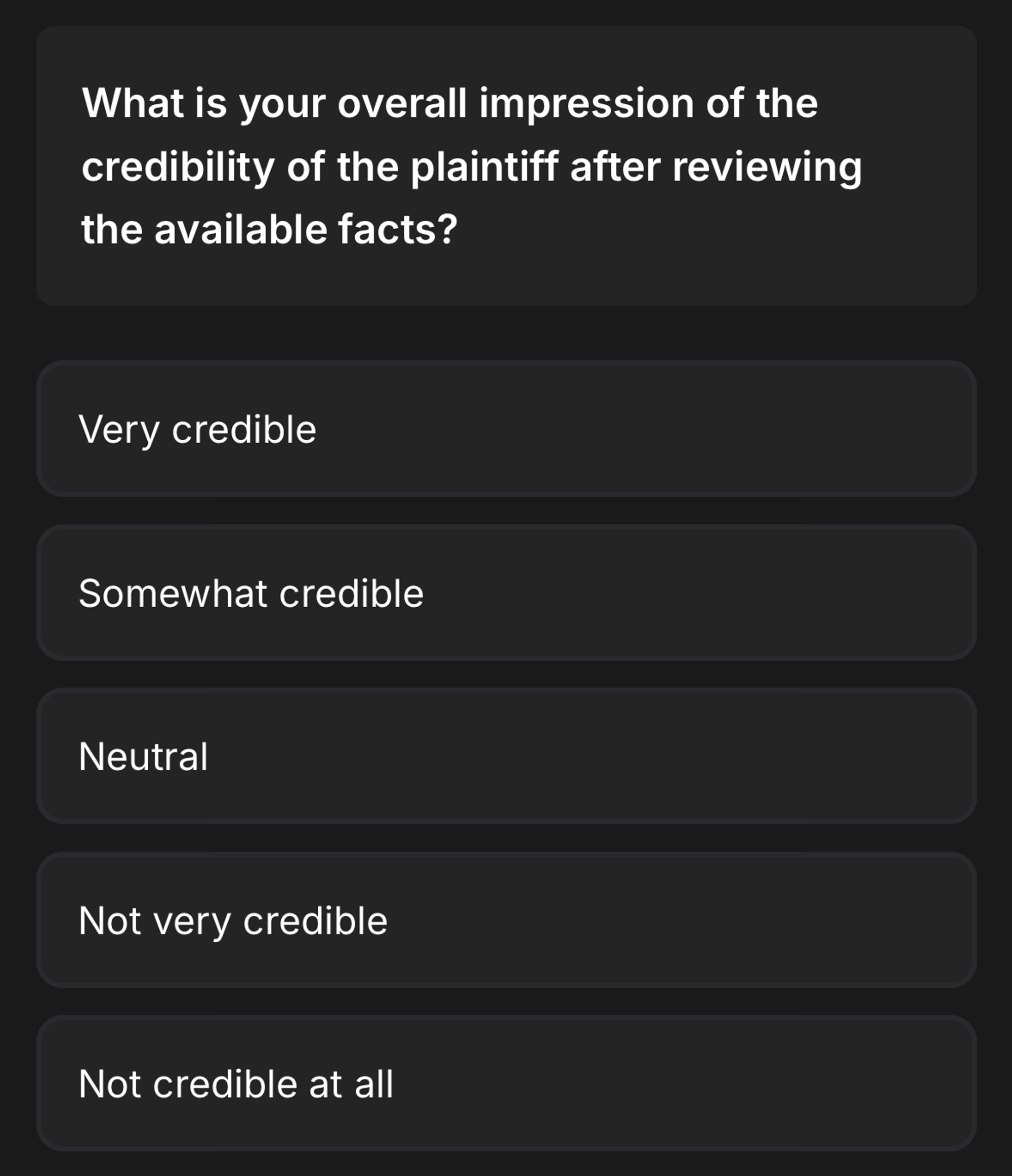
Opinion Distribution shows the share who chose each answer. Someone who doubts the incident caused the whole condition may still attribute the setback to it. If the question offers only agreement or disagreement with “The incident caused the injury,” you lose the distinction you need to discuss payment for the aggravation. Agreement scales have a second problem: shown a statement, people tend to agree with it, whatever it says.2 Positions such as “Only the truck driver,” “Only the car driver,” “Both drivers” and “Neither driver” tell you more than “Strongly agree” to “Strongly disagree.”
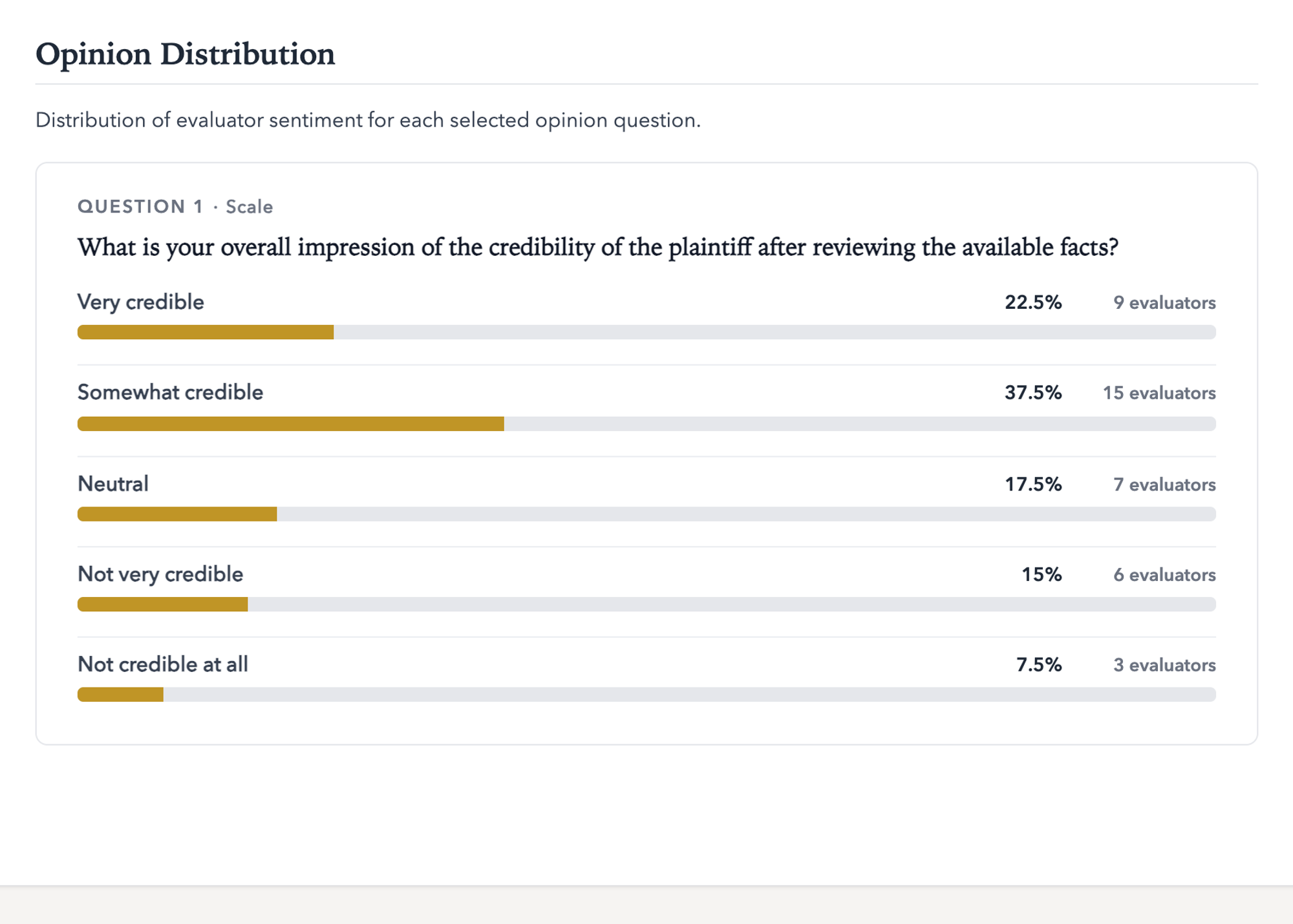
More ways to ask:
- How much weight a witness gets. “How much weight would you give the eyewitness’s account?”, with answers from very heavy weight to none.
- What one fact does, in both directions. “The store’s video of the fall wasn’t kept. How, if at all, does that affect your view of the store’s responsibility?” The answers run from “Much more likely to hold the store responsible”, through “No change”, to “Much less likely”.
- How serious the conduct was. “How would you describe the defendant’s conduct?”, with answers from reasonable care, through ordinary carelessness and serious carelessness, to reckless disregard and deliberate wrongdoing. To test punitive damages, ask a separate question that uses the instruction for your jurisdiction.
- An attitude a defense depends on. “If a product meets federal safety standards, does that mean it was safely designed?”, with yes, no and it depends.
- Several answers at once. “Which facts most influenced your decision about fault? Select all that apply.”
Percentage
A Percentage question works for a share of harm or cost. “What share of the claimed lost earnings does the evidence support?” Evaluators can answer from 0 to 100%. The report groups the answers into bands, so you can see how much of the claim evaluators allowed and how widely they differed. Add a written question if you need to know why. You can add the question in Set Up.
The 54 cases we reviewed contained 16 Percentage questions across 14 cases, written between January 2 and September 13, 2026. Twelve of them asked about fault, responsibility or blame. On a civil case, use Fault Allocation for that job. It collects all the parties’ shares in one answer and pairs them with awards in Award Impact.
Source: Focus records of Percentage questions in the same 54 cases, checked November 24, 2026.
More ways to ask:
- How much of the harm the incident caused. “What percentage, if any, of her current trouble with balance and walking do you attribute to the fall?”
- What would have happened otherwise. In a medical case: “How likely is it that earlier treatment would have prevented the injury?”
- Lost capacity. “How much, if any, of his former ability to work do you think he has lost?”
- Whether a warning would have mattered. “If there had been a warning on the product, how likely is it that she would have followed it?”
Ranking
Ask which facts mattered most in deciding who was responsible. Give each fact its own entry. Evaluators can rank two or more and leave the rest unranked. Ranking Analysis shows the average rank, how many ranked each item and how many skipped it.
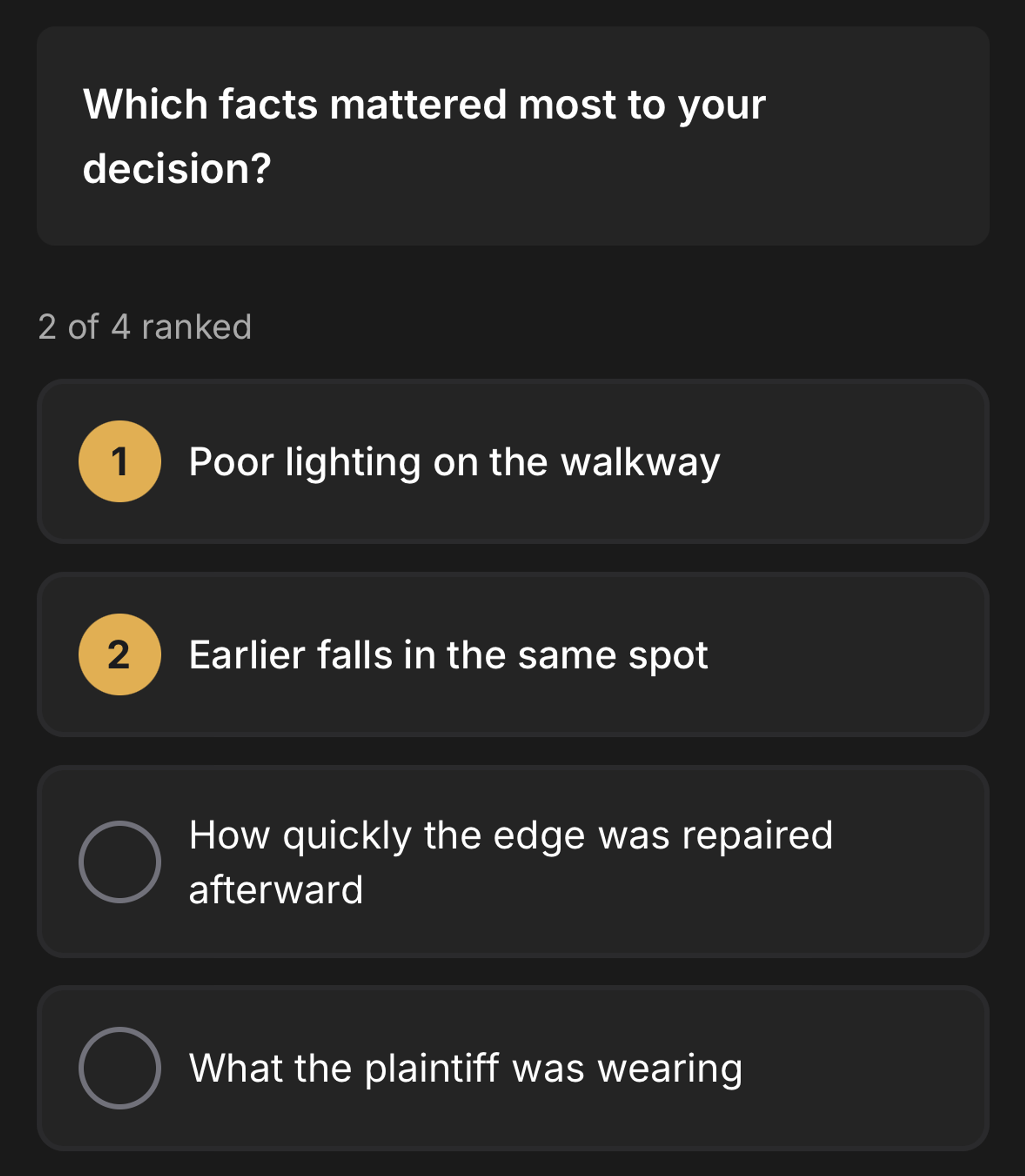
Read those counts before choosing what to lead with. A fact can rank near the top among the few people who used it and be absent from everyone else’s list. In the example below, 34 of 40 evaluators ranked the earlier falls. Only 9 ranked what the plaintiff was wearing, and the other 31 left it out. A fact most of the panel ranked, and regularly put near the top, gives you a stronger reason to lead with it in a demand.
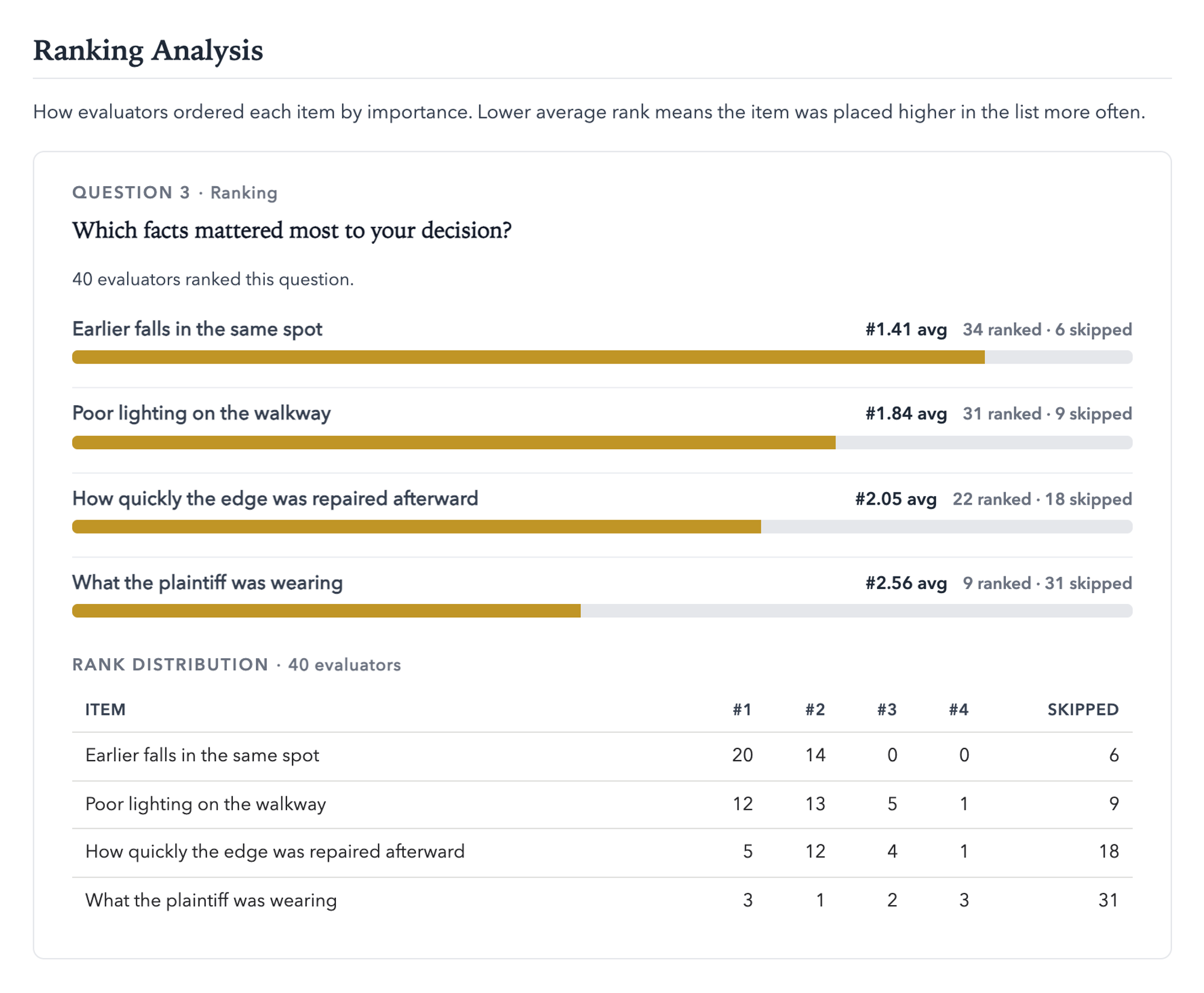
More ways to ask:
- Which harm lands. Rank examples of how the injury changed the plaintiff’s daily life.
- A legal test with several factors. When the question is whether a worker was an employee or an independent business, rank the kinds of control by how much each one counts.
Writing neutral questions
Ask one thing at a time, in words someone can read on a phone. “Torn cartilage in her hip” works if that’s what the medical record describes. Ask what evaluators think, not what they predict. “Would a jury find the company liable?” asks them to guess about other people. “Do you think the company is responsible?” asks for the judgment you’re paying for. For a dollar question, name the person, the losses and the period it covers, and say whether to deduct for fault.
A question that leans one way can pull the answers in that direction, and the number you take into a negotiation is then less reliable. When a question describes a disputed fact, say who claims it and give the other side’s account too. Offer answers that run the full distance in both directions, with room to say the evidence is insufficient.
| Leans one way | Neutral |
|---|---|
| “How do you square the early improvement after surgery with the later reports of pain?” | “How, if at all, do the records from after the surgery affect your view of the injury?” |
| “What is your first reaction to the claim that the owner ignored earlier complaints about the stairs?” | “The customer says the owner had complaints about the stairs before the fall. The owner says those complaints were about another stairway. What do you make of the two accounts, and why?” |
| “If an expert testified that the toxicology result was unreliable, would that change your view?” | “One expert says the toxicology result is reliable and the other says it isn’t. How much weight do you give the result, and why?” |
| “How much of his former ability to work has he lost?” | “How much, if any, of his former ability to work do you think he has lost?” |
| “The incident caused the injury”, from strongly agree to strongly disagree | “Which best describes the effect of the incident?”, with named positions that include “The evidence is insufficient to tell” |
Focus Intelligence drafts questions from your case files, and you can change any of them in Set Up. See how Focus works for attorneys and for insurers.
Notes
- Shari Seidman Diamond, Mary R. Rose, Beth Murphy and John Meixner, “Damage Anchors on Real Juries,” Journal of Empirical Legal Studies 8 (2011): 148–178. The study followed 33 plaintiffs in 31 Arizona civil trials whose jury deliberations were recorded, and reviews the earlier experiments, including Gretchen B. Chapman and Brian H. Bornstein, “The More You Ask For, the More You Get: Anchoring in Personal Injury Verdicts,” Applied Cognitive Psychology 10 (1996): 519–540. SSRN. ↩︎
- Jon A. Krosnick, “Survey Research,” Annual Review of Psychology 50 (1999): 537–567, at 552–553. Across ten studies, 52% of people agreed with a statement, while only 42% disagreed with its opposite. PDF. ↩︎