
Monday, November 23, 2026
What’s New in Focus: From Case Files to Litigation Strategy

In this post
When we launched Focus in January, our goal was to make venue-specific litigation research accessible to more legal teams.
Since then, we have expanded the platform across the entire research process, from AI-assisted case analysis and strategy development to advanced reporting and the analysis of competing perspectives.
Here’s what we’ve built since launch:
- Focus Intelligence. Case analysis grounded in your own files, and a research strategy built from it.
- More ways to test a case. Ranking, Fault Allocation and fair ranges on awards.
- Deeper analytics. How damages, liability and the evidence relate to one another.
- Peer Influence. Whether evaluators change their award after reading competing views.
- Confidentiality and collaboration. Redaction, reports tailored to each reader, and controlled sharing.
To see all of it on a case like yours, book a 30-minute live demo.
Focus Intelligence: from case files to research strategy
Rather than starting from a blank case, you begin with the file you already have: demand letters, depositions, medical records, police reports and photographs, as PDFs or images.
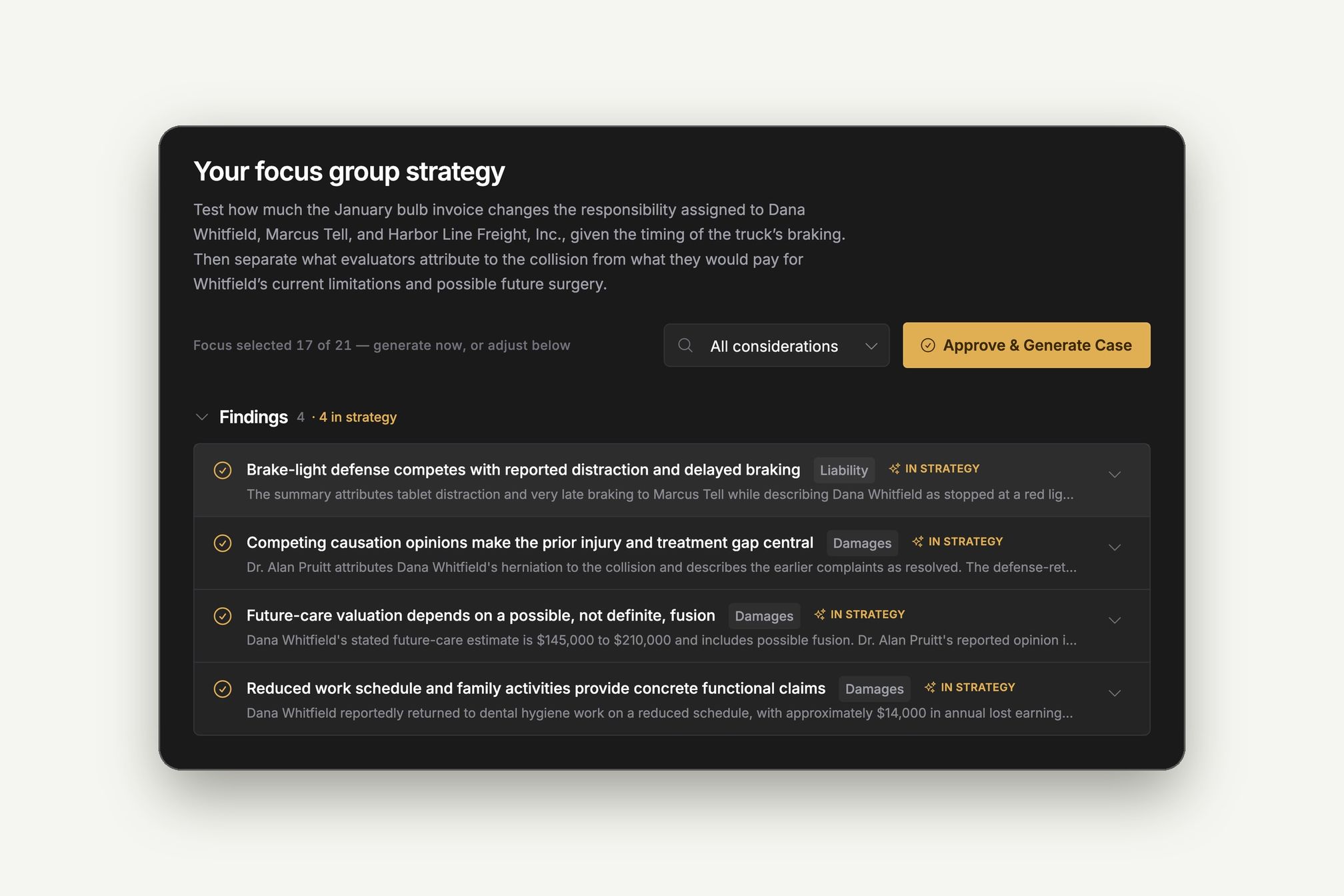
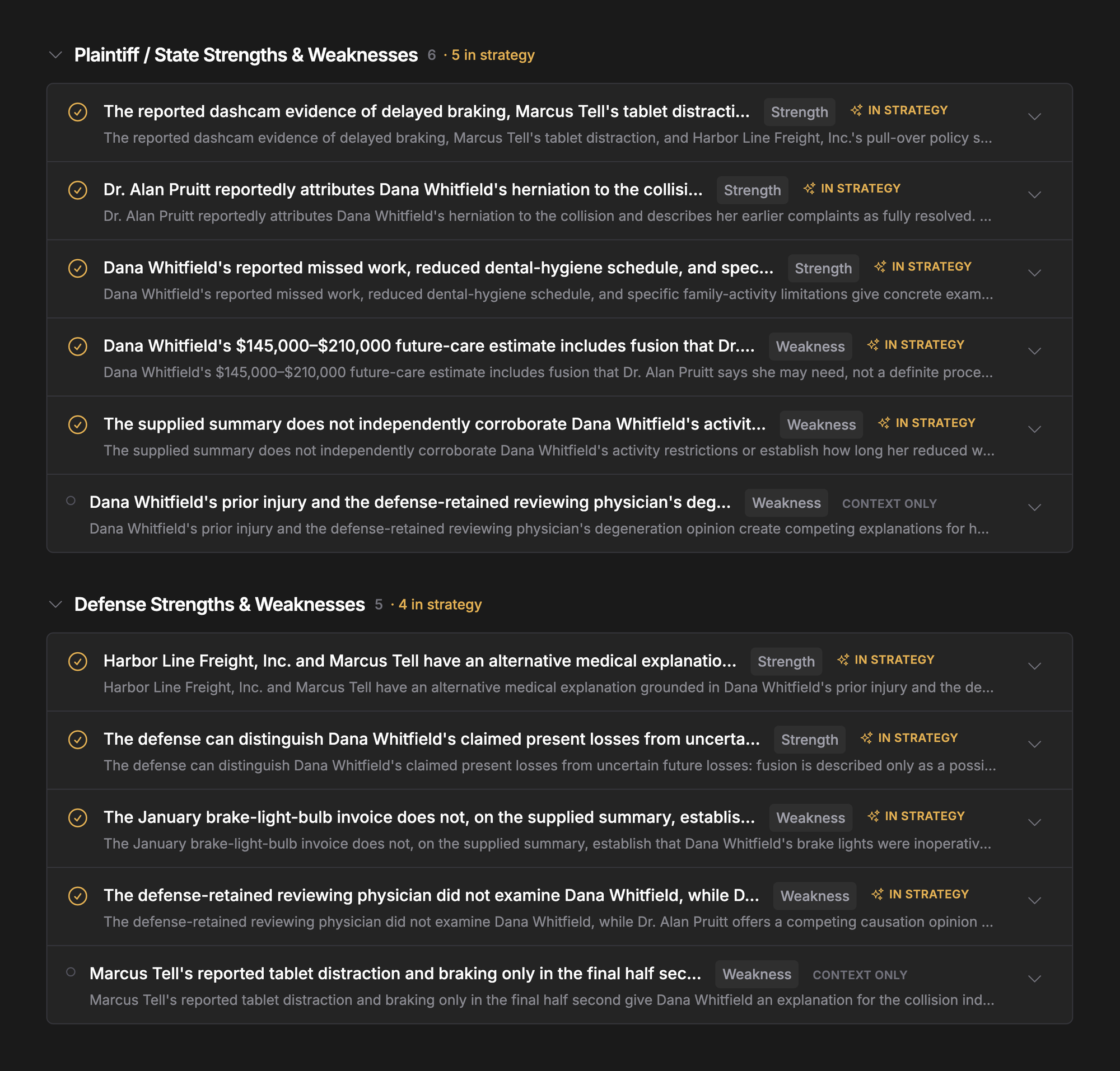
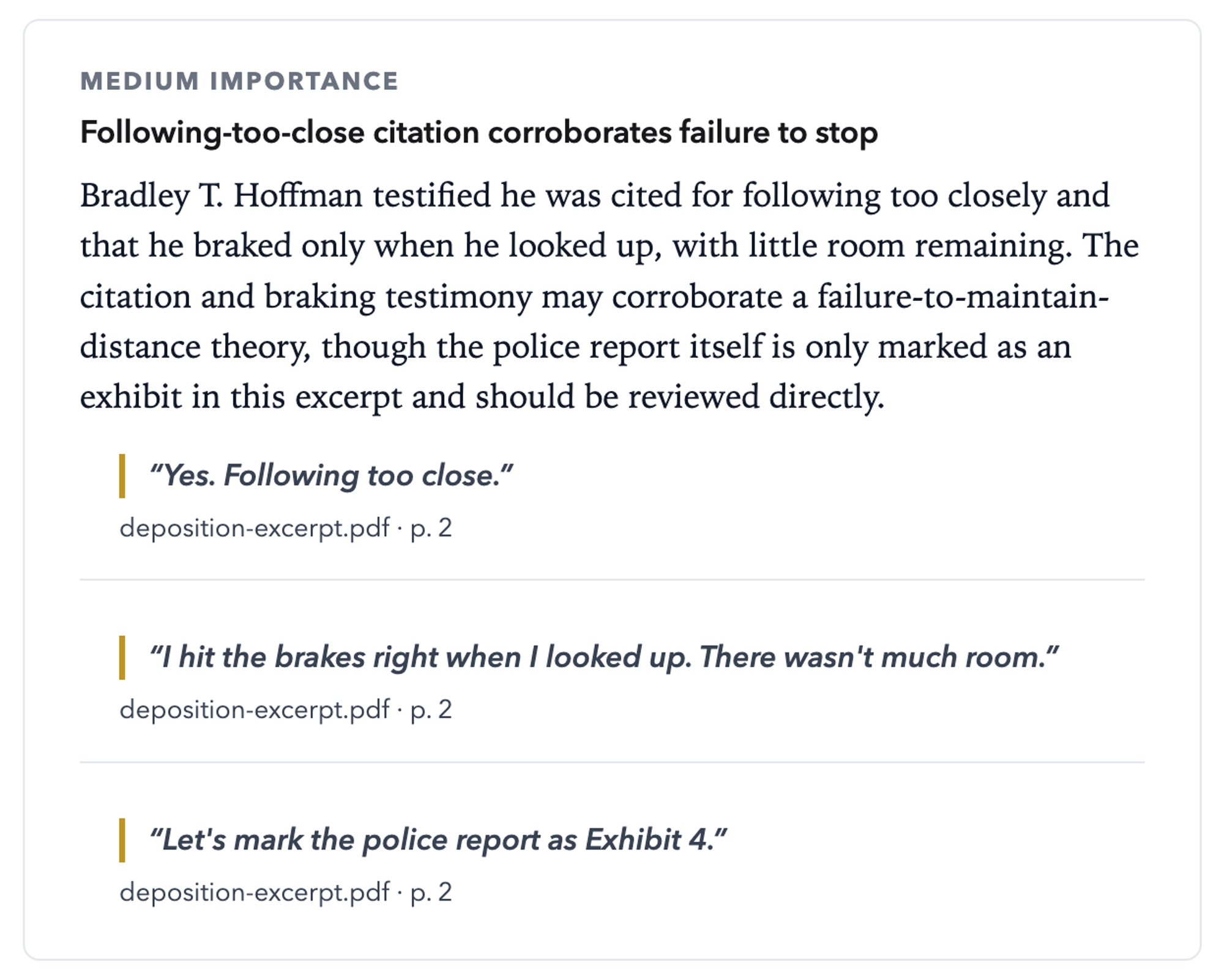
Focus Intelligence analyzes them to identify key findings, set out each side’s strengths and weaknesses, and recommend a strategy for testing the case. Where a finding cites a passage, you can check it against your own documents.
Once you approve the strategy, Focus drafts the case facts and the research questions and recommends exhibits. You keep full editorial control over what evaluators see.
The analysis is also available as a standalone strategy report, for case reviews, client discussions and litigation planning before a focus group begins.
Focus Intelligence is free during the beta. The product guide walks through each step.
More ways to test your case
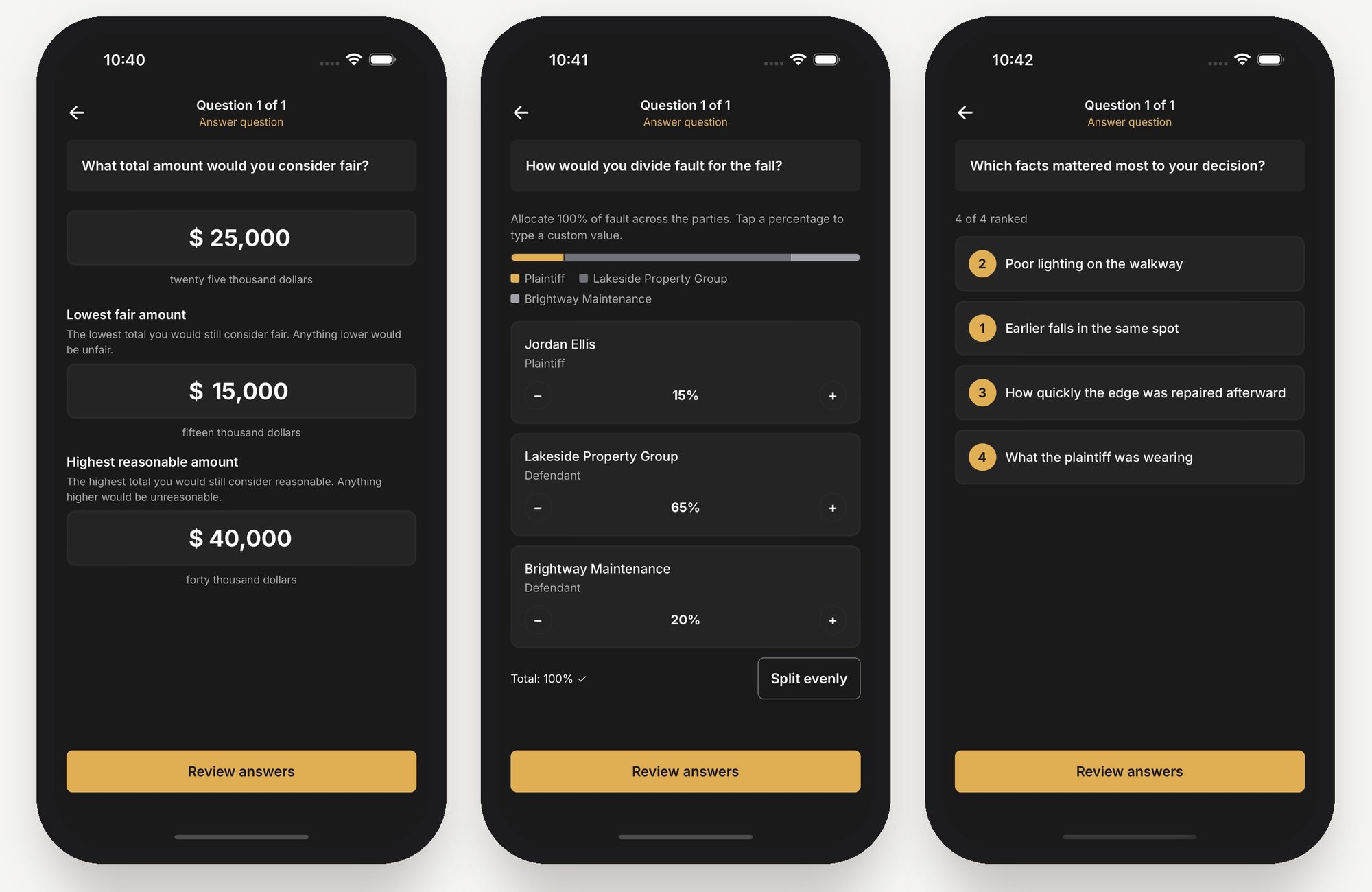
Focus added two question types and an optional fair range on Amount questions, so you can design research around the specific uncertainties in a case.
Ranking shows which facts, exhibits, witnesses or arguments evaluators consider most important or persuasive.
Fault Allocation captures how evaluators divide responsibility among the parties, for a closer read on liability and comparative fault.
A fair range on an Amount question captures the lowest amount an evaluator would still consider fair and the highest they would consider reasonable, which shows how much room there is in each valuation.
Legal focus group questions explains when to use each type.
Deeper insights into damages and liability
Understanding case value takes more than an average award. Focus reports now show the judgments behind the numbers.
Award Analysis
Award Analysis gives several views of the same damages: the mean, the median, an adjusted mean and the distribution of individual awards.
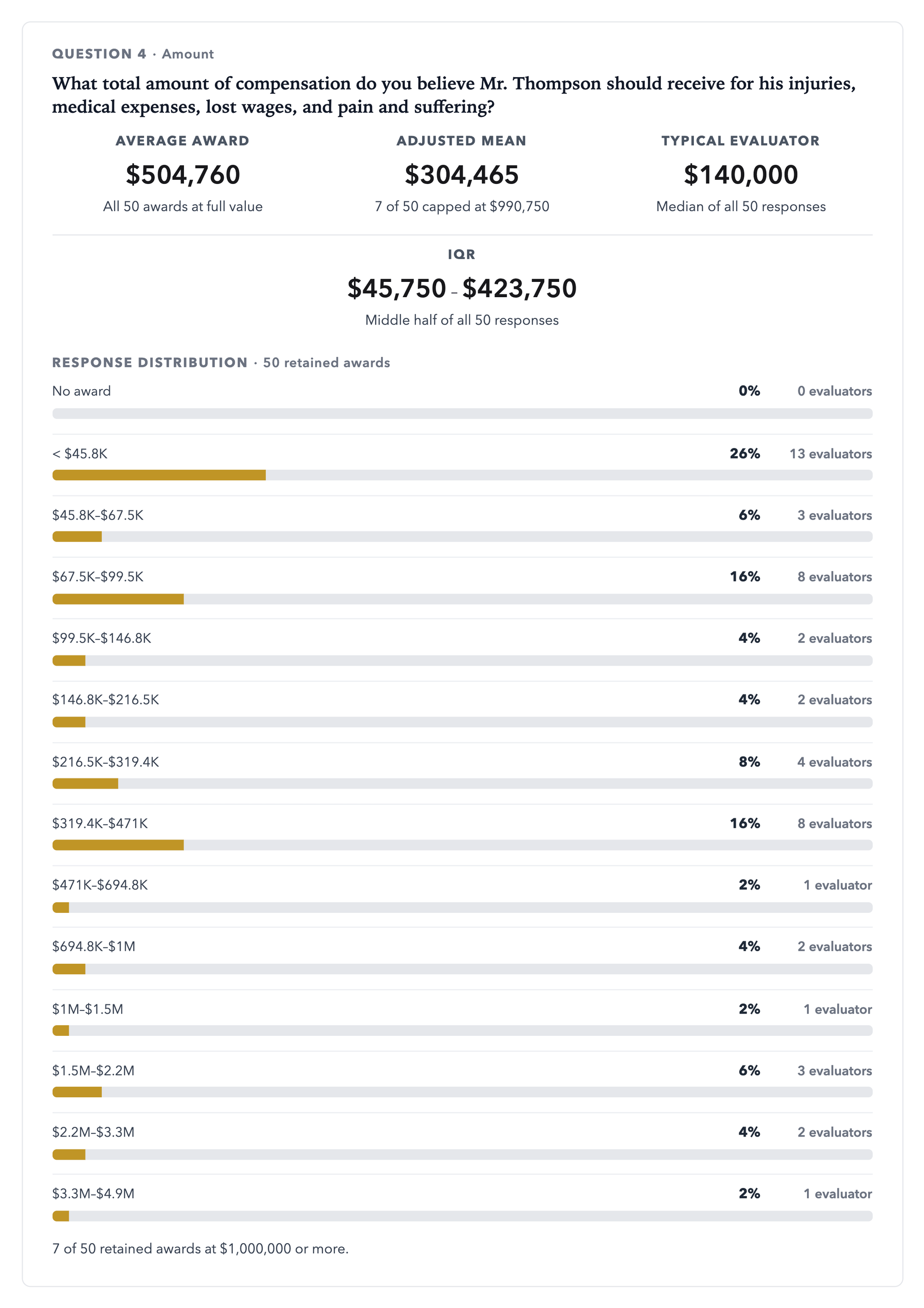
In this example the average award is more than three times the median. Half the evaluators awarded $140,000 or less, and seven of the 50 awarded at least $1 million. Read together, the figures separate what a typical evaluator would award from the exposure at the high end. How to read focus group award numbers goes further.
Award Impact
Damages and fault are related judgments. In 18 of the 20 focus groups we studied, the half of the panel that put more fault on the plaintiff also gave the lower median award. Award Impact keeps that relationship by pairing each evaluator’s award with that evaluator’s own fault allocation.
A second example report · 50 evaluators
- Combining averages: the $754,250 average award reduced by the 12% average fault on the plaintiff
- $663,740
- Award Impact: each award reduced by that evaluator’s own fault allocation, then averaged
- $738,433
- Difference between the two calculations
- $74,693
In this second example, a low-speed rear-end collision, combining the two averages would have understated the result by nearly $75,000. Award Impact reports proportional fault-adjusted damages: it reduces each award by that evaluator’s fault share and does not apply your venue’s recovery rule. Comparative fault in a focus group explains the calculation and how applicable law affects recovery.
Trial Analysis
Which readings of the evidence go with very different awards, and what did the panel still need to know? Trial Analysis answers both from the evaluators’ own responses.
In the same example, one question asked whether the low speed, the limited vehicle damage and the absence of ambulance transport made a serious neck injury harder to believe.
The same example · median award before fault
- 26 evaluators who disagreed or strongly disagreed
- $1,200,000
- 8 evaluators who were neutral
- $61,250
- 16 evaluators who agreed or strongly agreed
- $25,000
Evaluators who disagreed awarded 48 times as much at the median as those who agreed. The overall median of $700,000 hides that split.
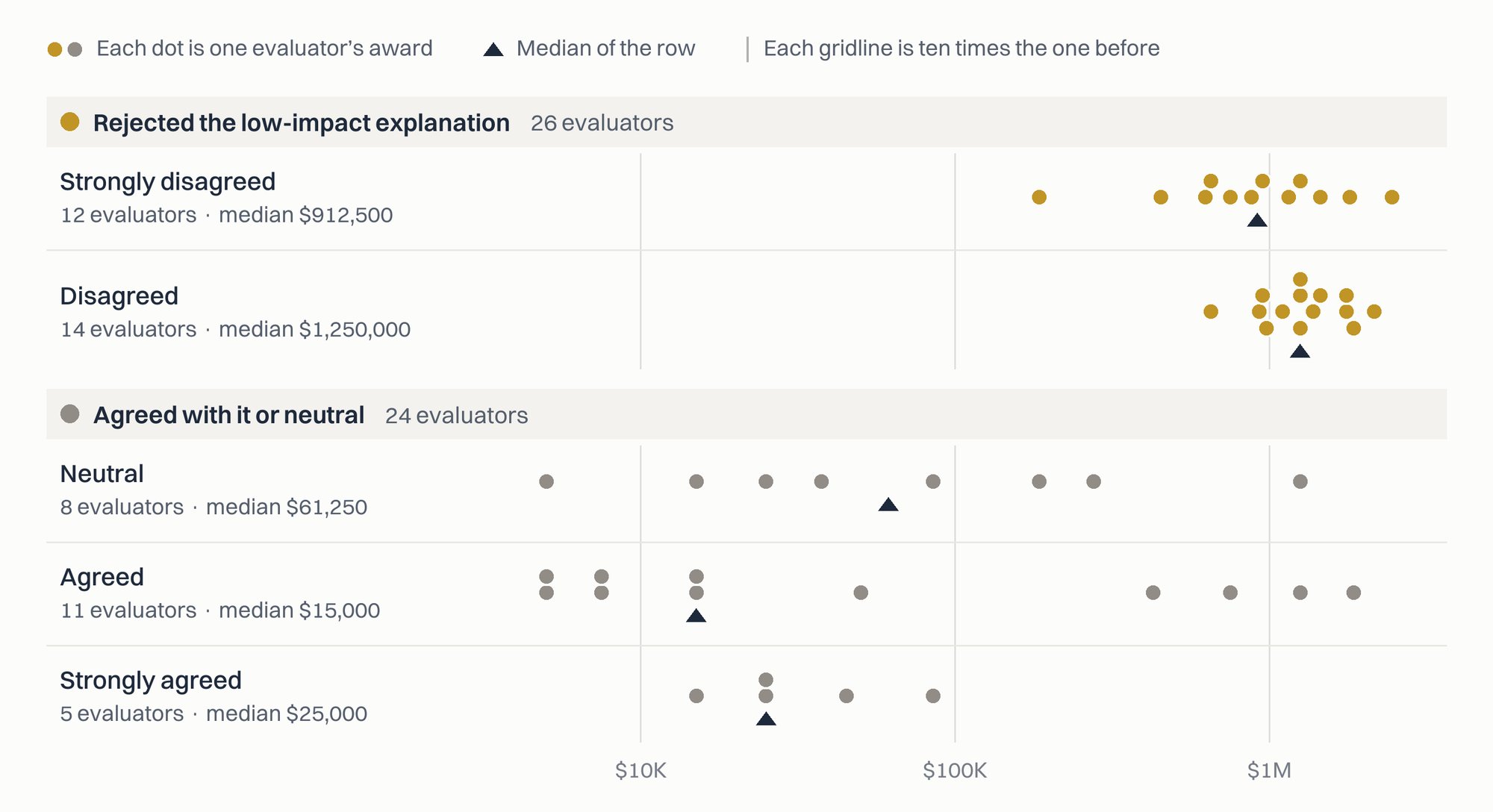
Trial Analysis also helps identify gaps in the evidence and unresolved questions that may warrant further investigation before mediation or trial. Here, evaluators who gave high awards and evaluators who gave low ones wrote the same condition: they would count the future surgery if a doctor tied it to the crash. The panel had not seen the treating physicians’ opinion on causation, which gives counsel a specific issue to address before mediation.
Trial Analysis is available on completed Gold, Platinum and Elite cases built with Focus Intelligence.
Beyond first impressions with Peer Influence
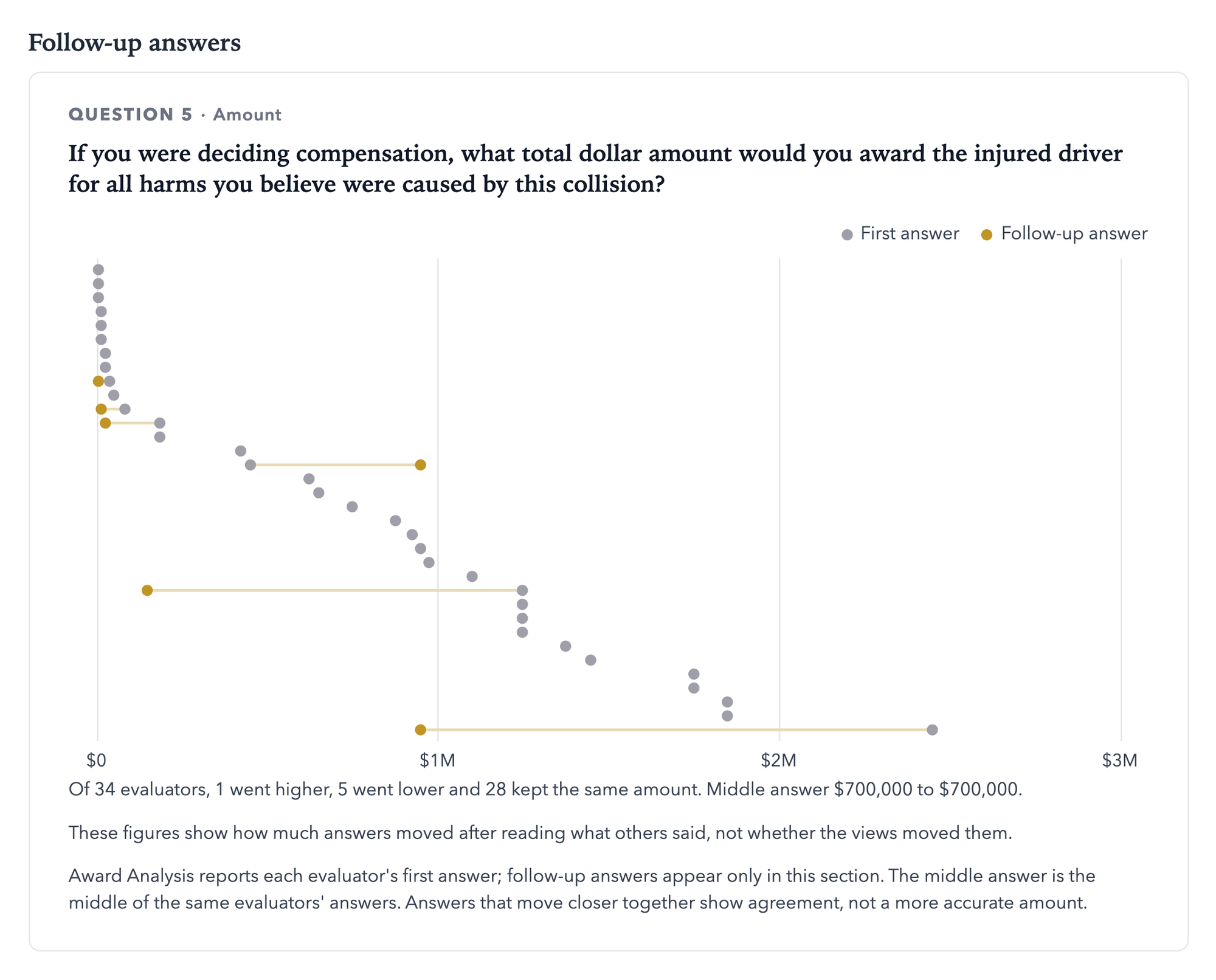
Independent evaluations show how people read a case on their own. Peer Influence shows what happens next: whether they change their award after reading competing views.
On eligible Gold, Platinum and Elite cases, evaluators who have submitted their evaluation can choose to read a few short views drawn from the panel’s written answers, then answer the main award question again. Focus keeps the original answers and reports the follow-up answers separately, so you can see which amounts held and which moved, and by how much. The report shows the movement, not what caused each change.
Peer Influence explains how the views are written and checked.
Greater control over confidential information and reporting
Focus can now redact the personal information it detects in PDF and image attachments. You review the redacted copy and add anything it missed before evaluators see the exhibit.
Reports can be tailored to the reader: the litigation team, a client or an external recipient, each with its own executive summary and choice of sections. When you share a report from Focus, you invite recipients by email, see whether they have opened it, and revoke access when the matter is done. A copy someone has already downloaded stays with them.
Take another look at Focus
Whether you are valuing a claim, setting a reserve, preparing for mediation or getting ready for trial, Focus lets you test your assumptions against independent answers from evaluators in the counties you choose.
If you looked at Focus earlier this year, book a 30-minute live demo and see what has changed, or see plans and pricing.
The report examples in this article are illustrative and do not represent actual case results.